Showing posts with label Social Media. Show all posts

Thursday, December 21, 2017

Teen Depression and Suicide Linked to Smartphone Use


by Kathy Mahoney

NPR recently published a story about the dangerous connection between smartphones, depression, and suicide rates in teens. Research has shown a sharp increase in depression symptoms, suicide risk factors, and suicide rates in teens since 2012, coinciding with the time smartphones became popular.

The study found that teens who spend five or more hours a day on their phones are 71% more likely to have one risk factor for suicide. The amount of screen time, no matter the content, correlated to higher rates of depression.

The author of the study stated that “three hours a day and beyond is where you saw the more pronounced increase in those who had at least one suicide risk factor."

Recommendations for parents included limiting use to two hours per day or less. When not using smartphones, teens should be engaging in activities that promote mental health, such as exercising, seeing friends and family face to face, sleeping, and getting outside. Furthermore, the author reports that the ideal age that a teen should get a smartphone is 14, when they enter high school. Studies show that younger teens may be more vulnerable to the demands of social media.

To read the article in full, click here.

Thursday, October 19, 2017

Finsta! What is it?


by Stephanie Worthley

Image result for finsta

It's not just Instagram and Snapchat teenagers are using to express themselves. More and more teenagers are creating a Finsta - a fake Instagram account. Because Instagram now allows users to create and toggle quickly between multiple accounts, teens starting creating Finsta accounts in addition to their Instagram account. Why would someone create a Finsta account? Basically, teenagers are using their Finsta accounts to hide posts from their parents, teachers, employers, coaches, and even other peers. 

Finsta is a place where teenagers can be themselves outside of the filter-driven, perfect-photo culture of Instagram. While most teenagers often post to Instagram to gather a high number of likes and quick compliments, on Finsta, it is understood that likes, perfect photos, and comments are not the goal. Instead, many can post photos to express their real feelings, post imperfect photos, and share feelings that they may not always feel comfortable sharing in public. However, this is a place where teenagers are showing off pictures of illegal activities, such as drinking, drugs, parties, or sexual pictures - pictures that they would never post in a more public Instagram account (like the account their parents and family members are following). Finsta accounts are created to throw parents off of the teenagers digital path. Finsta accounts usually have fewer followers and engage with only a close circle of friends.

Here are some Finsta Realities:
  • Most teenage have a Finsta (although they will deny, deny, deny); while teenage girls dominate the space, boys are also active despite playing a less active role. Most teens (regardless of frequency of use) keep a Finsta account to remain privy to social hierarchy and look out for their own eventual targeting by other users.
  • It is more common to have a Finsta, than to not have a Finsta. Why? The platform allows teens to celebrate their social improprieties despite articulating or simulating remorse to parents and school officials. In other words, they are able to maintain a “sorry, I’m not sorry” persona on social media, while articulating the opposite in the public setting.
  • Although Finstas may begin with good intentions, most ultimately digress into a conduit for cyber aggression, or fan the flames of social drama in the form of likes, comments and regrams.
  • Finstas that create mental, social or emotional trauma are subject to school-related discipline if and when they eventually bleed into and disrupt the school learning environment. The lines of outside bullying and school have become increasingly blurred by social media platforms.
  • Upon discovery, teens easily (and alarmingly) convince parents the Finsta is “only a joke” or “actually never used”, and quickly change their handle (name) to advance the premise that it has been deleted. Rarely, if ever, do they actually delete their Finsta.
Ask your son or daughter to show you their Finsta account. It may be difficult to find it, depending on the account name and the photo that is used to create the profile picture.

Resources:
https://www.today.com/parents/parents-you-know-about-instagram-do-you-know-finsta-t117541

https://securingtomorrow.mcafee.com/consumer/family-safety/finsta-parents-know-teens-fake-instagram-accounts/

https://www.huffingtonpost.com/entry/what-the-finsta-the-darker-world-of-teenagers-and_us_57eb9e03e4b07f20daa0fefb

Thursday, October 27, 2016

How to Monitor Social Media


By Jen Dondero

On October 18th, Russ Becker and I hosted the 8th grade parent coffee. We discussed a variety of topics, but one that always leads to great conversations and sharing of concerns and  ideas is Social Media. The main concerns were how to monitor it, when to monitor it and when to step in and get involved. It's easy to understand why there is confusion and uncertainty, my quick google search of “How much should I monitor my child’s social media” came up with millions of articles and after reading 7 articles, it is clear that even the experts have very different opinions on how to best monitor and protect your child while he/she is online. Some experts say “Have discussions but there is no need to monitor” while others advocate “using technology to monitor their technology use” (apps such as MamaBear send alerts when their kids send or receive friend requests, use certain words, or are tagged in photos. They also provide GPS tracking). The advice is dizzying and the pace of technology makes it difficult for parents to keep up with the ever evolving app choices. My best advice to to find a middle of the road approach. These are my tips for navigating the digital world with your adolescent

  1. It should be understood that iPads/phones/computers are owned by the parent and therefore not the child’s personal belonging. They can be taken away as a consequence for poor choices on technology.
  2. Regular communication about expectations and rules must occur so that both parent and child know the boundaries and also consequences for infractions. The conversations should center around safety and making responsible choices.
  3. There is no way to monitor everything your child is doing online. Some experts believe over monitoring will lead children to become more sneaky and secretive online. However, spot checking should be expected. Children should know that whatever they type/send/post can be recaptured and resent to others and there is no expectation of privacy online. You are spot checking not to invade their privacy but instead to keep them safe and ensure they are being responsible digital citizens.
  4. As children age from “tween to teen” monitoring (especially of text messages) can decrease if a child has shown they are mature and capable of balancing online activities and real life expectations (homework, extracurriculars etc). Caroline Knorr of Common Sense Media recommends “parent should discuss boundaries and appropriate online behavior with their children and to ‘parent around the device’ by ‘doling out features sparingly’ when the phone is new. She suggests opening up more features as the child demonstrates the ability to ‘follow the rules and meet expectations and understand consequences.’”
  5. Set the expectation that if your child is on a social media site (Instagram, snapchat, Facebook, twitter) they must friend/allow you to follow them. Again, nothing posted online is private and therefore if they are posting something publicly they can expect their parents to see it.
  6. Set device free times in your home. Some families choose to have technology free hours at dinner, in the car or after 9pm. Only allow cell phone usage at certain hours in the evening or after homework has been completed. If you have teens of driving age, the most important rule to enforce is that under no circumstances should cell phones ever be used while driving. Phones should be kept off so incoming text sounds aren’t a distraction or should be kept in the glove compartment, out of reach

http://www.cbsnews.com/news/should-parents-snoop-on-their-kids-online/


Friday, April 1, 2016

Where does technology come in from a social/emotional learning perspective?

by Tracy Allen

Technology has brought wonderful and exciting new things to learning in our district. Last week's DLD day was an opportunity for teachers to share what they're doing with each other. It truly is amazing to see technology's impact from a student perspective. 

Where does technology come in from a social/emotional learning perspective? This question was addressed as part of a larger discussion about technology and schools with a panel moderated by Blake principal Nat Vaughn and made up of  IT Directors from other school districts as well as our own Superintendent Jeff Marsden. The S/E component can not be separated from the educational component, according to one of the panelists. Digital Citizenship and ethics around device use are part of that conversation. One place that we, as a department, will start exploring more are the programs, apps, and digital resources that guidance counselors, particularly at the middle school level, can be used in the guidance classes. 

One great presentation on DLD day was about an app called Social Stories. Students for whom previewing social situations helps could read and reread a story created by a teacher or counselor before actually encountering potentially scary events like the first day of school or when a teacher takes a maternity leave. This app was originally developed to help people with autism preview new situations. However, I think the app could appropriately used for a number of our students.

In my 6th grade guidance classes, I am asking kids to think back to things that made them nervous about entering Blake. They are using the app to create stories, all in the first person so the reader can imagine himself/herself in that situation, that would help answer questions and preview experiences that might be "scary" when entering the middle school. I hope to have a variety of scenarios available on the guidance website this summer to help quell pre-Blake jitters.

As the direction of technology in the classroom has been so exciting to watch, I think the journey of technology in S/E learning will be equally exciting.

Friday, November 6, 2015

7th Grade Parent Coffee

On Wednesday, November 4th, Mrs. Dondero had coffee with the 7th grade parents. Mrs. Dondero presented the parents with information about Emotional Intelligence, Stress and Anxiety Management, Self-Discipline and Motivation, 7th Grade specific information, and App Awareness. The parents in attendance seemed most interested in learning more about the Apps that their children are using, and the Apps they should stay away from. Here are some potentially dangerous apps that are popular among kids:
1. Tinder
2. Snapchat
3. Blendr
4. Kik Messenger
5. Whisper
6. Ask.fm
7. Yik Yak
8. Poof
9. Omegle
10. Down

To learn more about these Apps, please click here: 

Wednesday, October 21, 2015

8th Grade Parent Coffee

by Stephanie Worthley

This morning, October 21st, Mr. Marenghi presented to the parents of the Class of 2020 (!) on 8th Grade Specific Information, Academic and Social/Emotional Developments, Self-Discipline and Motivation, Stress and Anxiety Management, and Future Planning/Transition to High School. 
Of the many interesting topics discussed, here are two highlights:

Executive Function:
According to Harvard University’s Center for the Developing Child, “Adults can facilitate the development of a child’s executive function skills by establishing routines, modeling social behavior, and creating and maintaining supportive, reliable relationships. It is also important for children to exercise their developing skills through activities that foster creative play and social connection, teach them how to cope with stress, involve vigorous exercise, and over time, provide opportunities for directing their own actions with decreasing adult supervision.”

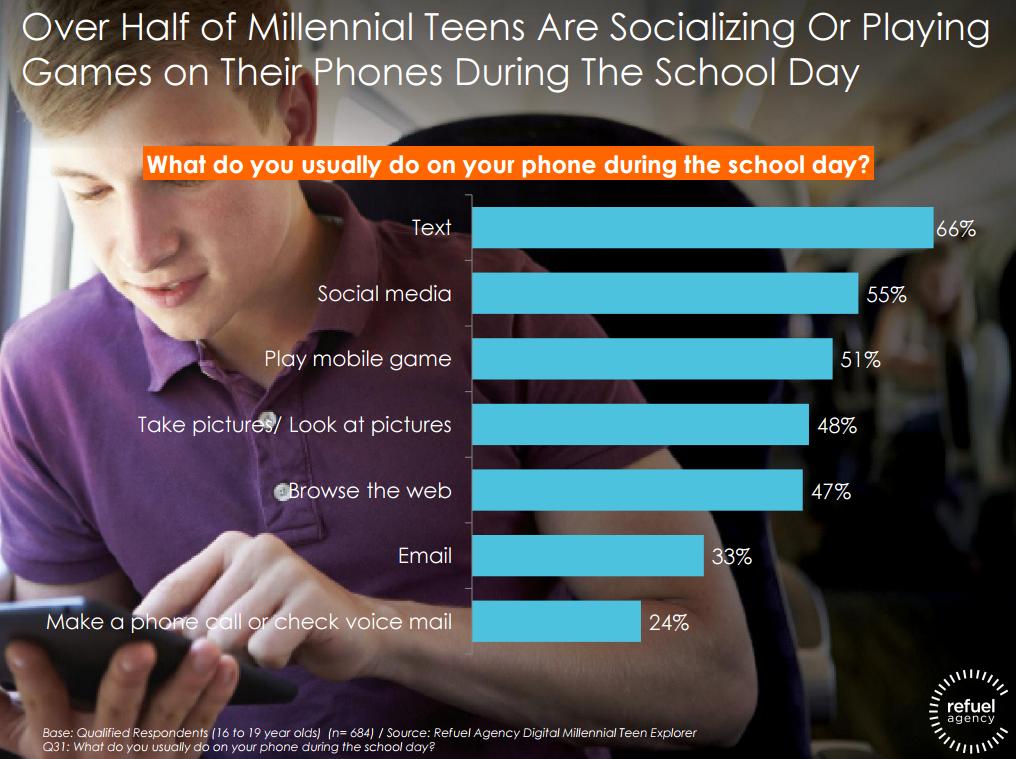
Mobile Social Device Use:

What are our students doing on their phones?