Showing posts with label Future Plans. Show all posts

Tuesday, February 9, 2021

College Admissions Webinar


On Wednesday, January 28th the Guidance Department hosted a college panel for juniors and their families. This year's panel included admissions representatives from Clemson University, College of the Holy Cross, Northeastern University, UMass Amherst, and the University of Vermont. The panelists shared their expertise around the admissions process and offered tips for current juniors. Here are a few pieces of advice that came from the panelists:

  • Don’t take courses in high school that you won’t do well in! It’s about balance and appropriately challenging yourself

  • If you plan to apply to a MA state college or university, make sure you take math your senior year to meet the four year requirement

  • Feel free to reach out to your school’s admission’s representative. For example: “I’m really interested in your school, this is my intended field, which course do you think would be better for me to take senior year?”

  • Be careful of senioritis, but don’t feel like if your grade goes from an A to a B+ in a class that your admission offer will be revoked. 

  • There is no correlation between the topic of your essay and the quality of your essay. If you have fun writing the essay, we will have fun reading your essay. Choose a topic that is interesting to you!

  • Make sure you check out the virtual offerings available on each college’s website. This is a great way to learn about the college and also demonstrate your interest.


If you were not able to join us or want to revisit what you heard, you can view a recording of the webinar here. 


Thursday, September 5, 2019

Colleges Coming to MHS!


by Stephanie Worthley

During the fall, college admissions counselors are hitting the road and spending their days visiting high schools. The purpose of these visits are twofold. First, college admissions counselors have the opportunity to educate students about their schools. Admission counselors share about programs and activities available at their school. This is often an initial point of contact between students and colleges. Secondly, students get to learn first-hand about a college that may or may not be on their radar. This time allows students the chance to meet face-to-face with an admission counselor and ask specific questions. Many times, this is an opportunity for students to make contact with the person who may be evaluating their application in the future. 

At Medfield High School, we have over 100 college admission representatives coming to visit this fall! Juniors and seniors can see the list of colleges that will be visiting MHS and sign up to meet with the representatives by following these steps on Naviance:
  • Sign in to your Naviance account at: http://connection.naviance.com/medfield 
  • On the home page, scroll down to the box labeled "What's New"
  • You should see a list of colleges that are scheduled to visit MHS. Be sure to click "Show More" to see the complete list. 
  • To attend the college visit session, click on "More Info" next to the college name.
  • Click on "Register" in the top right hand corner to sign up.
These college visits are a great opportunity to learn more about a college and have a chance to get questions answered in a small group setting. We encourage all juniors and seniors to explore the list of colleges coming to MHS and sign up on Naviance today! 

Thursday, April 11, 2019

Advice From Senior Parents

by Amanda Padden

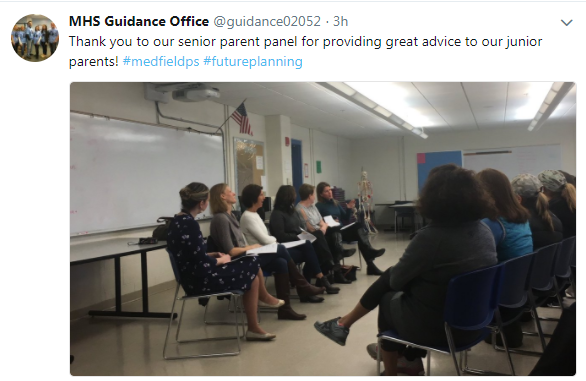
On April 11th the Guidance Department hosted a parent coffee for junior parents where a panel of senior parents shared advice about supporting their child through the college application process. Thank you to Faith Bannister, Monica Bushnell, Tina Caro, and Erica Reilly for being a part of the panel!

Below is a summary of the advice that was shared based on what worked best for each family.

Organizing the college application process

  • One strategy is to pick one day a week to talk about college so as not to overwhelm your child with college talk- especially if they aren’t much of a talker.
  • Keep a spreadsheet of the colleges and their deadlines
  • The Fiske Guide to Colleges and Demystifying College Admissions are great books to refer to.
  • Let your child drive the process and know that not everything will be done in the most efficient way. Yes, it’s helpful to have the college essay written before senior year begins, but if your child isn’t feeling inspired and in the mindset to write at that time it might not turn out to be the best essay.
College visits
  • Build some fun into it. Find the best consignment store in town or enjoy fun things to do in the area. Eat in the dining hall.
  • Keep it casual. Your child doesn’t have to decide if they are going to apply right after the visit. Think of it as simply gathering information about likes and dislikes
  • Know that there’s no perfect school for anyone. Instead, think about what qualities each school on your child’s list has that would help them to be happy and successful. 
  • After the college tour don’t say anything. Let your child talk first about their thoughts
  • One parent referred to a daunting part of the college info sessions called “the slide” where the admissions counselor brings up a slide with statistics about the number of AP courses, GPAs, and standardized test scores for their applicants. This can feel defeating to your child, but just because they don’t meet all that criteria it doesn’t mean that they won’t be accepted. Colleges are marketing themselves and want to appear selective.
Applying and deadlines
  • Apply where you want to go. It can’t hurt to try even if it’s a reach. Just make sure there are matches and likelys on your list.
  • Keep your blinders on. Social media and talk in the community can make things difficult. Do what you feel is right for your family and your child. 
  • Keep in mind that many Medfield students apply early action and will hear back in December. It can be difficult if your child hasn’t sent in any applications while their peers already have decisions in hand. Applying to a few likely schools early if your child is ready may be helpful. At the same time, applying regular decision can be nice because everything feels less rushed in the fall. 
  • There comes a point with the SATs or ACTs where the scores don’t change much. Taking one or both tests twice was the common number. At some point students should focus their energy on something else they have more control over.
  • Interviews- if you can, consider not interviewing the same day you do the campus tour and info session. It will be easier to go into an interview after you’ve had time to process your thoughts from the visit. If a college offers an optional interview and it’s one of your child’s top choices definitely take advantage of it. A lot of the big schools don’t provide it as an option. 
  • Whether or not interviews are offered have your child get to know the regional rep for each college. They can be a great source of information and an ally in the process. It can almost turn into an informal interview. 
  • ED is tricky as some students have a first choice early on in the process and then change their mind later on as they learn about more schools. You also may not have as many opportunities for merit scholarships and you are saying “yes” to a school before knowing what the financial aid looks like. The plus side is that if it’s truly the first choice and financially it works for the family, it might help to give the student a bit of an edge in the admissions process.
  • Don’t not apply to a school because of the price tag. One parent said that they would be paying less to go to a private school than UMASS because the private school offered merit scholarships. You never know what you will be asked to pay.
  • A great tip about the college essay- “If your child’s college essay fell out of their notebook while walking down the hallway at school and their name wasn’t on it, would people know it was theirs?” 
After decisions are released:
  • Know that you can only control so much. Help your child understand how to “separate the decision outcome from their own self worth”. Your child’s application could be amazing in every way, but you never know what the admissions committee’s priorities are that year. They are building a class.
  • Be open to unexpected outcomes. There may be disappointment with one school but a surprise yes at another school. One child was accepted to a college but was asked to go abroad for the first semester. It’s possible your child could get into their dream school but then realize when they get there it’s not what they expected. Sometimes the “nos” can lead to something else great. 
  • There are going to be “speed bumps and potholes” along the way, so expect that going into it. In the realm of life, your child is going to get nos- not getting the job they interviewed for or the promotion they want, etc. That’s your biggest role as a parent is to support them through the nos they will inevitably experience in life. 
  • Social media during decision release can be tough. There are group chats for colleges and oftentimes students are alerted about the date and time decisions will be released. Students immediately post their outcomes to the group chats and this can be overwhelming. Consider making a plan about how your child will manage this before decisions are released.
  • Tell your child “I don’t care what the sweatshirt says, I’m going to wear it with pride” whether its a selective school or not.

Monday, February 11, 2019

College Panel Highlights


by Amanda Padden

Last Thursday, the Guidance Department hosted a college panel where juniors and their parents heard about the admissions process from Bentley University, Boston College, Hobart and William Smith, UMASS Amherst, The University of New Hampshire, and Westfield State University. Here are a few highlights for those who were unable to make it:


Academic Supports at the College Level
  • The Banacos program at Westfield State offers support for students with Learning Disabilities and ADHD. Students who are accepted into the program are placed in classes with professors who are a good match for their learning style, get priority course registration for the first two years, and are assigned a program advisor who is a point person for any accommodations they may need. Students must submit cognitive and achievement testing, have a minimum GPA of 2.5, and interview with the program staff.
  • There are many different academic supports offered to all students at the college level including resources like tutoring and writing centers and peer tutors. Check with the colleges on your list to make sure that they offer the kinds of supports you will need to access. 
How colleges view students who apply undecided as a major
  • All six colleges say that being undecided is ok. Hobart said that they love undecided students. Students take an academic survey over the summer that help the deans place students with an advisor who is a good match and select freshman year classes that will be of interest to them.
  • Although being undecided is ok, there are certain majors that students cannot transfer into later. Often times these majors are Engineering, Nursing, and sometimes Business. BC for example says that students can’t transfer into the school of management, so they should apply to that academic division first and transfer out later.
  • UMASS made the point that if a student selects a competitive first choice major (like Nursing, Management, Engineering, or Computer Science) that they should pick a second choice major outside of that competitive college so they still have a chance to be admitted to the university if not admitted to their top choice major.
  • Students will want to check with their colleges to see if there are any majors or academic divisions that they can’t transfer into later
Is it better to have a high grade in a C1 or C2 course or a lower grade in an Honors or AP course?
  • UMASS and Westfield ad a .5 bump to the GPA for an Honors course and a 1.0 bump to the gpa for an AP course. 
  • In general the admissions counselors agreed that students should take courses that are an appropriate challenge for them. If you have all As in C1 classes and never take an honors course, that’s not a good thing. If a student earns all Cs in all Honors and AP courses then that’s not helping them either. Students should get feedback from their teachers, guidance counselor, and parents, and think about balance. 
  • Some colleges recalculate their own GPA. BC looks at the average grades in core subjects for every grade level. Hobart doesn’t recalculate, they take note of the rigor of the high school, strength of courses, and standardized tests if submitted. 
The college essay
  • Admissions counselors read the same stories over and over again like, “the day i got cut from the basketball team” or “the time I scored the last goal at my soccer game”. One of the most memorable stories was an essay about a pair of sneakers that a student loved.
  • Remember, this is not a writing assignment. It’s a chance to get to know you as a person. Write in your own voice and write about something important to you. Ask yourself “what do I want the essay to achieve and how will I do that?” or “What quality about myself do I want admissions to know about and how will I illustrate that quality?”
Interviews
  • If you have a first choice college make sure you reach out and ask if there’s an opportunity for an interview. For Hobart, it’s a red flag if a Medfield student hasn’t met with her because she lives locally and is very accessible.
  • If interviews are optional, it’s important to ask how important it is. Are they simply informational for the student or are they part of the admissions process?
  • Make sure you ask about the deadline to have an interview. Summer or fall of senior year is typically a good time. 
Volunteering vs. working?
  • No activity is more valuable than another. Admissions counselors simply want to know how each student spends their time outside of the classroom. Make sure to list any hobbies, jobs, or family responsibilities!
  • If a student is working 30 hours a week to support their family and takes no advanced classes because of that, they will take note of that in the admissions process.
Testing
  • There is a minimum standard set by board of higher ed for Westfield. SATs can be waived if the student has a documented disability. Admission decisions based on GPA and SAT.
  • Most schools agree that the SAT score can’t replace a student’s courses and grades. They also said that test prep can be a helpful resource, but it’s not essential or expected.
Deadlines
  • Admission deadlines and rates vary per college. For some colleges there’s a slightly higher admissions rate for Early Decision (binding) candidates. ED can help students who would be on the fence during regular admission get accepted. 
  • The colleges agreed that if it’s important to compare financial aid packages hat the student should not apply ED.
  • An advantage for regular decision is that admissions can see the first semester of senior year grades, so if students are unhappy with their 9th-11th grade grades, they may want to apply regular decision. 
Letters of recommendation
  • Ask a teacher from a core subject area. It doesn’t have to be the teacher who gave you the best grade. Oftentimes a teacher letter isn’t the “game changer”, but instead confirms what the admissions counselor is already perceiving from the application. Teacher letters can help make decisions about special invitations to honors programs (UMASS)
  • Counselor letters can be really helpful to give context or explain a transcript. Be sure you get to know your counselor so they can write a detailed letter for you
Pieces of advice for students and families:
  • Westfield- make sure you visit! Go to college fairs, see if junior visit days are offered, see if far away colleges have a regional rep you can talk to if you can’t get to campus. 
  • Bentley- Make an effort to know admissions counselor who is reading for your territory
  • UMASS- there’s no one school for you that you have to get into and all is lost. Keep an open mind. It’s all about what you make of it, the opportunities and the people you meet. 
  • BC- trust the process and just focus on what you’re doing in school. Don’t worry too much about the admissions process and how decisions are made.
  • Hobart- let the student be the driver. We want to hear from students not parents. Set aside one day a week to talk about college and not have it be a constant conversation. 

As you can see, there are different policies for every school, so be sure you are asking questions as you narrow down your list. The Guidance Department believes that there is a school for everyone and we will be here to individualize the process for every student and their family. Please reach out to us if you need anything and we hope that those of you who attended enjoyed the event!

Thursday, October 18, 2018

Declining Resilience in College Students

By Kathy Mahoney
Resilience. It’s a word that pops up often when talking about youth, so much so that it is the theme of our Advisory program at MHS this year. What is resilience and why should we, as educators and parents, care? Definitions include the ability to recover quickly from difficulties, or being able to bounce back when faced with adversity. Research has shown that this trait is linked to future success and happiness.

A recent article from Psychology Today reports that colleges are seeing an increasing number of students that lack this quality. Counseling services are overwhelmed, professors are frustrated with students’ inability to solve even the simplest problems, and students are not learning to become responsible adults. How did we get here? And what can we do about it?

Dan Jones, former president of the Association for University and College Counseling Center Directors, says, “[Students] haven’t developed skills in how to soothe themselves, because their parents have solved all their problems and removed the obstacles. They don’t seem to have as much grit as previous generations.”

Dan goes on to say that he’s not trying to throw parents under the bus, as parents face many societal pressures raising kids in today’s world. These pressures have led them to manage and structure their kids’ lives in order to keep them safe, and to help them reach their potential, both noble goals. The downside, however, has been a “decline in opportunities [for kids] to play, explore, and pursue their own interests away from adults.” Anxiety and depression are up, and kids have less sense of control over their lives. When young people are not given opportunities to learn how to solve their own problems, get into trouble and find their way out, experience failure and realize they will survive, they become college-aged students that don’t know how to take responsibility for themselves, needing adult intervention when a problem arises.

In today’s world, a balance between structure and independence is needed if we are to build resilience. “If we want to prepare our kids for college—or for anything else in life—we have to counter these social forces. We have to give our children the freedom, which children have always enjoyed in the past, to get away from adults so they can practice being adults—that is, practice taking responsibility for themselves.”

Visit this link to read the article.

Monday, October 15, 2018

The Financial Aid Process


by Amanda Padden

Last Thursday Justin Munio, Financial Aid Officer at Harvard, talked with Medfield families about the financial aid process. The presentation was offered through the Massachusetts Educational Financing Authority (MEFA), which is a not-for-profit organization that helps families plan, save and pay for college. You can view the powerpoint on the guidance website to see the presentation, but I’ve included some main highlights and take away points below:
  • Check the financial aid website for all colleges you are applying to. Deadlines are very important. If you are applying early to colleges then financial aid documents may be due early as well.
  • The FAFSA and the CSS profile are the two forms that families typically have to complete. The FAFSA is free, but the CSS profile is not. Not all colleges require the CSS profile.
  • There are multiple sources of financial aid:
    • Federal Aid: You can get this by completing the FAFSA. This aid comes in the form of grants, loans, tax incentives and work study
    • Massachusetts Aid: Grants, scholarships, tuition waivers, and loans. (John and Abigail Adams scholarship determined by MCAS scores)
    • Institutional aid- offered by the individual colleges in the form of grants, work study, and scholarships.
    • Merit scholarships- some schools offer merit scholarships based on academics, athletics, the arts, etc. Many highly selective colleges (like the Ivys) don’t offer it because everyone is high achieving in the applicant pool.
    • Scholarships- local scholarships (Medfield students will get information about these in March) and scholarships from other agencies.
    • Of note- parent loans are NOT financial aid. You’ll want to look for grants, scholarships and student loans on the financial aid award letter.
  • Cost of Attendance
    • Direct expenses- tuition, fees, room/board
    • Personal expenses: books, travel, etc.
  • Cost of Attendance
  • Expected Family Contribution (EFC)- This is the minimum amount a family should be expected to pay for one student for one year. This is redetermined every year. An increase in income increases a family’s EFC. Savings does increase it, but only slightly.
  • Financial Aid Eligibility (need) is calculated by taking the COA and subtracting the EFC. Every college has a net price calculator on their website. Families can enter their personal information on each college’s website and get an estimate of their EFC.
  • Many colleges offer payment plans throughout the year so you do not have to pay your EFC in one lump sum.
The financial aid process can feel overwhelming for many families, but there are a lot of resources available that can help. Check out the following:

  • FAFSA Day is November 4th- families can get free assistance with filling out the FAFSA from a financial aid officer. Click here to view FAFSA day locations and to register: https://www.masfaa.org/fafsa-day-register/
  • MEFA offers After the College Acceptance seminars where families can get assistance with reviewing award letters and discuss loans, payment plans and questions that families should ask the financial aid office. These seminars are in March and April.
Always feel free to contact financial aid offices directly to ask questions. They are there to help!

Thursday, April 5, 2018

“Let them drive the process….”


by Erik Ormberg


Five senior parents reflect on the future planning process


In early April the MHS Guidance office invited junior parents to hear from a panel of five senior parents as they shared thoughts on the future planning process. After two future planning events, two visits to classrooms and an upcoming college fair it was time for the guidance counselors to step aside, stop talking and let the parents in the trenches shares some insights, anecdotes and trade secrets.

We had a nice mix of “landing” spots. Two of the parents had kids committed to Providence College, two more were on the fence, one with Villanova and one with Temple and a final speaker’s child was going to decide between Loyola, Maryland or High Point University. The event was moderated by third-year guidance counselor, Kathy Mahoney.

Guidance department head, Stephanie Worthley kicked things off by welcoming the crowd of about forty and quickly turned things over to the panel.

Some general takeaways:
  • Tremendous stock was put in visiting colleges while school was in session and not during the quieter summer months.
  • Get a jump on essay writing and try to complete the common application over the summer.
  • Respect where each individual kid is in the process and allow a conversation to be had, or a spreadsheet designed or an essay assignment “outsourced” to a tutor.
  • Give the college admissions tests (ACT/SAT) their due diligence, but don’t sign up to take them more than 2 or 3 times.
  • Letting the students drive the process.
That last takeaway was a common thread that tied the entire morning together. As parents of seniors began the process they were intent on guiding their child and not becoming an overbearing presence amid the challenging timeframe of future planning with it’s written and unwritten deadlines.

One parent shared how their family began the process. The student was asked to come up with twenty schools based on interest. That list was then whittled down after a few visits and further research. She went on to explain that as a junior her son “THOUGHT” he wanted to go far from home, but as the sense of urgency became more real and vivid, he tended to look at schools closer to home.

At the end of the day is was clear to the audience that these five parents were not looking to relive a visceral experience through their children. A sense of individual pride permeated the discussion. And that pride wasn’t based on competitiveness or winning any specific brass ring. The pride was based on the fact that each parent knew their child had great options ahead of them.

And the driving force behind that? They let their child drive the process.

Tuesday, April 3, 2018

Sophomore Parent Night Recap

by Julia St. Jean

March 22, 2018 was the first annual Sophomore Parent Night run by the Guidance Department. The evening was filled with guidance-related information for sophomores, including a thorough junior year timeline, an overview of the sophomore guidance curriculum, an emphasis on the importance of life balance, an introduction into college and career readiness tools, and much more. In case you missed it, here are some takeaways from Stephanie Worthley, Russell Becker, Kathy Mahoney, Erik Ormberg, and Amanda Padden!

Sophomore Curriculum
During sophomore year, the Guidance Department connects with the entire sophomore class in classrooms about relevant topics to keep on their radar. During this interaction, counselors address and define high school transcripts, GPA and graduation requirements. Counselors also introduce Naviance (our online college and career platform) and it’s particular career exploration tools, including a Career Interests Profiler, which asks students a series of questions in order to determine which careers may be good fits as well as help students understand and set up resumes. These classroom visits get the process started in thinking about postgraduate plans as they relate to careers and best preparing students for their futures.

What Can Sophomores Do Now?
  • Attend the TEC College Fair at Westwood High School, which will be held on Wednesday, March 28, from 6:30-8:30
  • Career Speakers are coming to Medfield High! Individuals from different professions, including a Pediatric Nurse, Psychologist, Engineer, Sports Broadcaster, ESPN Talent Producer, Business Professional, and Teacher, are coming to visit the school to discuss the ins and outs of their particular career path.
Resources for Sophomores with Amanda Padden and Kathy Mahoney

In this breakout session, counselors drove home the importance of viewing sophomore year as a time of exploration and curiosity- what are your strengths and interests? How can you complement these through various types of involvement and conversations? We then walked through different available resources that help to support that exploration, including Naviance and Big Future- particularly which careers may be a good fit, how to get there, and what courses may be helpful to take.

Balance with Erik Ormberg and Russell Becker

Guidance Counselor Erik Ormberg and Adjustment Counselor Russell Becker focused on the importance of balance for high school students, encouraged families to discuss how they define success and how to accept and learn from stumbles along the way. They also spoke about mental health statistics in the greater Boston area and different mental health resources available to students and families, including speaking with our School Adjustment Counselor and reaching out to the Interface Helpline at 1-888-244-6843, which helps to connect individuals to therapists in the area.

Breakout Sessions: 
Guide to Postsecondary Planning for Students with Disabilities with Kathy Mahoney
Alternative Future Plans with Amanda Padden
Postgraduate Planning for Artists, Athletes, and Musicians with Erik Ormberg

There is an academic, educational, and career path for each student. While the process may feel daunting (which is very normal!) it is also incredibly exciting. Part of this juxtaposition of feelings is the hefty amount of options for students: what support services are available? What are my options once I receive a high school diploma? What if my college application requires a portfolio? These are all great (and common!) questions. As a Guidance Department, and school, there are resources, and people, here to help, and to hear, your questions, goals, and dreams, which will be unique and subjective for each student. Come visit us in Guidance to speak more about these topics!

Thursday, February 8, 2018

GAP Year Programs

by Amanda Padden

       On Friday, February 2nd, Gap year representatives from Dynamy Internship Year, EF Gap Year, Rustic Pathways, and City Year spoke with interested 10th-12th grade students and their parents. A Gap year is an "experiential semester or year typically taken between high school and college (or whatever your future plan may be) in order to deepen practical, professional, and personal awareness." Below you can find a summary of what each of the programs has to offer.

Dynamy: This program provides students an opportunity to explore potential careers and learn to live independently. Students live in Dynamy provided apartments in Worcester with other Dynamy students and attend their internship site roughly 28 hours a week. 200+ internships are offered, in careers a such as animal care, business, film, radio, and teaching - there’s something for everyone. Depending upon the whether students choose the full year or semester option, students will have between one and three internships. Mondays are workshop days where students learn about communication, independent living, and professional skills. They also have a chance to participate in college seminars offered through Clark University and earn up to 12 college credits. College counseling is available as well.

At the beginning of the program, students spend a week in Maine on an outdoor adventure retreat where they bond with staff and other students before the Gap year begins. Dynamy offers need based financial aid and has rolling admission throughout a student’s senior year until spots are filled.They also offer tours and informational interviews. Check out their website at https://www.dynamy.org/internship-year/.


EF Gap Year: EF is the same company that Medfield uses for its China and Italy trips. EF Gap Year offers students a chance to travel, learn or continue a world language, participate in community service, and intern in a field of interest. The program starts with an orientation at a castle in London (seriously!) where students get to know their cohort of Gap year students. As part of the orientation they will travel on a welcome tour to London, Amsterdam, Paris, Rome and Barcelona. After this, students will spend six weeks taking language courses at one of EF’s seven language schools in cities like Paris, Barcelona, Tamarindo, and Tokyo while staying with a host family. Next, students will participate in a six-week service learning project in one of six international destinations like the Dominican Republic, Nepal, Peru or Tanzania. Students return home for the holidays and have the option to attend a college application seminar.

When they return from break, students travel on a three week cultural immersion tour in Australia and New Zealand. After that students will start their business internship (offered in eleven international cities) where they will live with another EF Gap year student. The Gap Year ends with a Leadership Academy at the castle in London where students learn leadership skills followed by a tour of Scotland and Ireland where they practice those skills.

If students choose to participate for one semester they will only choose two of three options (service, language, internship) and will not travel to Australia and New Zealand. Applications are rolling until May 31st or until spots fill up. Students can enroll as early as their junior year, but most apply during senior year. https://www.ef.edu/pg/gap-year-abroad/


Rustic Pathways: This program offers students an opportunity to travel abroad and participate in community service. Students pick a region of interest and will travel to various countries within that region while participating in different service projects. There are typically fifteen students in a group, two program leaders, and local guides in each destination. Examples of programs are Spanish Immersion and Service and South Pacific Service and Ocean Skills.

Other specialized programs like “Come with Nothing” offers an experience where students bring one carry on bag and five items and have to shop for clothes and other supplies at a local market to sustain them throughout the trip. Students will live, work, and participate in community service.

Dates vary depending on the program destination. Rustic Pathways also offers summer programs if students do not want to participate during the academic year. Scholarships are offered and program applications deadlines vary. Check out their website at https://rusticpathways.com/


City Year: This program is for students interested in dedicating a year of service to students who are at risk of dropping out of school. City Year volunteers focus on student attendance, behavior, and the their ability to access the curriculum. City Year volunteers are assigned to a classroom where there is a primary teacher. Volunteers build relationships with the students in the classroom who are most at risk. Volunteers will be trained for one month before they are assigned to a site. Volunteers can choose to live at home or be assigned to a site in another US city and live in an apartment. Volunteers receive a stipend of roughly $630 every two weeks and can apply through City Year for food stamps to pay for groceries. Volunteers are in the classroom Mondays through Thursdays and spend Fridays with their City Year cohort.

Upon completion of the program, volunteers earn a financial award called the Segal Education Award of roughly $6,000 which can be used to pay off college debt or be put toward future schooling. City Year partners with colleges like Wheelock and Bentley which offer students incredible financial aid awards to City year alums. The application process includes talking with a recruiter, filling out an application, and having an interview. There are various deadlines throughout a student’s senior year with the next deadline coming up in early March, 2018. This is a well known program that has a huge alumni network. Many graduates of City Year are later hired by City year alums. This is a great opportunity for students interested in careers in education, helping professions, and working with youth. https://www.cityyear.org/


       Guidance counselors are available to work individually with students on the Gap year application process. See your counselor if you are interested in a Gap year or stop by the guidance office to explore the brochures. We want students to know that college is not the only option when it comes to future planning. As always, the guidance counselors look forward to helping students find a future plan that is both exciting and a great match for their skills and interests.

Friday, September 22, 2017

Swimming with the Sharks - A Take on Selective Admissions

NACAC-2018-720x360.png

by Kathy Mahoney

Last week, I had the opportunity to attend the National Conference for NACAC - the National Association for College Admission Counseling. My first session focused on how best to counsel students and families in a competitive and demanding admissions climate. There are thousands of students applying to each school, and colleges have the difficult job of building an admissible class. This task includes denying talented students, many of whom meet the admissions criteria and would make fantastic students at their institution. With the number of applications rising and admissions rates falling, it’s no wonder that students and families feel like they are left swimming with the sharks. Here are two big takeaways to keep in mind as you go through the process.

     1). There is no such thing as fairness in the admission process. It’s easy to compare yourself with others around you, but try not to fall into that trap. “I have a better GPA than Johnny, but Johnny got in and I didn’t. That’s not fair.” However, Johnny plays the oboe and the college happens to be short one oboe player. GPA clearly wasn’t the only factor in this admission decision. The following year, Sarah says, “I have a better GPA than Johnny did and I’m a better oboe player!” Well, the school doesn’t need an oboe player anymore; their institutional priorities have shifted. Fairness in college admissions just isn’t possible.

     2). Think outside the box! In this case, the box is the Northeast and West Coast. These schools have been hit by increasing amounts of applications, leading to tougher standards and lower admission rates. By contrast, there are hundreds of great schools everywhere in between that might be a perfect fit for you! Colleges like geographic diversity and may be more likely to admit a candidate from a state that has little representation at their school. Keep an open mind and look at schools outside of our region to increase your likelihood of admission. There are some real gems out there!

Remember to work with your guidance counselor to come up with a list of colleges that is right for you. We look forward to helping you!

Tuesday, September 19, 2017

“ROLL TIDE!”: The SEC via a “drive-thru window approach”

by Erik Ormberg


During the second week of September I had the chance to attend the SEC (South Eastern Conference) admissions breakfast.

The group of college representatives presented in Portland, ME, Boston, MA and Providence, RI three days in a row.

The event can be summed up in three minutes. Literally.

Each school had three minutes to give their overview--and if they went over, the representative from Mississippi State rang a cowbell. Though not as subtle as the orchestra playing at the Oscars when recipients go over their time limit, the group--for the most part--stayed committed to their time constraints. Brevity was the main course at this breakfast forcing each school to get to the nitty-gritty of their admissions trends and policies.

Getting a snapshot from 14 schools in less than two hours is exactly how I want to get my information about schools that are over 1000 miles from Medfield.

Image result for thesecu.com

After a quick overview from LSU, each school’s representative performed their respective, “roll call.” Each guidance counselor in the room had to perform the college’s rally cry. So, we all engaged in ‘Bama’s “Roll Tide,” Auburn’s “War Eagle,” Florida’s “Gator Chop,” and Ole Miss’s “Hotty Toddy.”

Roll call got everyone moving and set the tone. Fourteen schools presented admissions trends and statistics, but also emphasized the large, VOCAL, vibrant school spirit present on each campus.

I had the pleasure of sitting next to Clay Alexander, admissions representative from the University of Tennessee. He looked like the endzones of Neyland stadium, adorned in an orange checkerboard shirt and vintage UT orange tie. “Rocky Top you’ll always be, home sweet home to me.”

Our conversation revolved around the recalculating of GPAs, rankings, and the strength of schedule and strength of institution. Though he didn’t go into detail, Clay did explain that the school profile provided by each high school plays a large part in admissions. The strength of a public high school may help enhance a student’s application.

Though this “drive-thru” approach didn’t dive deep, the materials given and the comments presented were extremely helpful in identifying schools for kids looking to venture beyond New England and the northeast corridor.

After leaving Providence, I thought about the senior girl in my office the day prior looking for a “safety-school.” Having her GPA and board scores still bouncing around my head made me realize she’d be a great candidate for the University of South Carolina’s honors college.

I wish more gatherings of colleges or leagues would follow suit. It is helpful for counselors to only miss part of their work day, yet still receive helpful professional development without having to travel hundreds of miles. “MIZ….ZOU!”

Thursday, June 1, 2017

Graduation Walk

by Stephanie Worthley

Last spring, I saw this story online about a high school in Texas starting a new tradition, The Senior Walk. The purpose at this event at Van High School in Texas was to inspire younger students to aim for college after graduation. The 150 seniors at Van High School walked through the halls in their caps and gowns as elementary and middle school students cheered them on. When I saw this I thought, “We HAVE to do this in Medfield.”

http://abcnews.go.com/Lifestyle/texas-high-school-seniors-senior-walk-inspire-younger/story?id=38934768

So today, Thursday, June 1st, was the first Graduation Walk through the Medfield Public Schools. The 218 graduating seniors walked the halls of Blake Middle School, Wheelock, Memorial, and the Dale St. School. Students and teachers lined the hallways and cheered for our seniors as they walked with pride through the halls. Students made signs of congratulations and gave high-fives to the seniors as they walked by. Teachers had class photos from elementary years and gave a lot of hugs to these young adults who were once small children in their classes. A student found his hand prints up in the Dale St cafeteria from 2004! And one student commented that it must be grilled cheese day at Memorial!

Thanks, Class of 2017, for taking this walk down memory lane today. You have made quite an impression on the younger students in the district, and your teachers couldn’t be prouder! Congratulations Class of 2017!

Check out a brief video slideshow of the Graduation Walk here:


Wednesday, May 10, 2017

Juniors Attend the National College Fair


By Kathy Mahoney

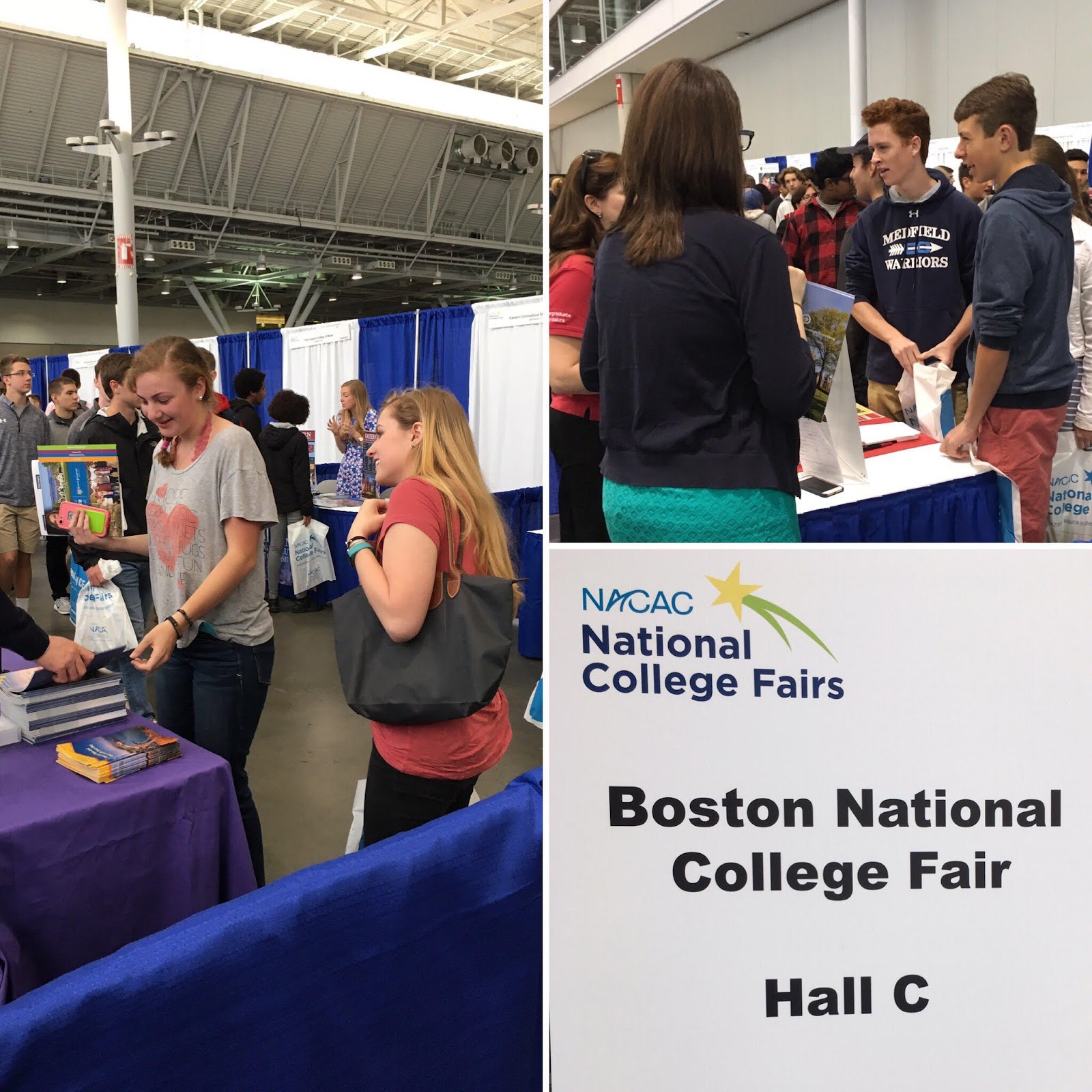
On Monday, May 8th, 116 juniors loaded buses and traveled to Boston to attend NACAC’s National College Fair at the Boston Convention Center. Over 400 colleges and universities were represented as students perused the aisles, making connections with admissions counselors and gathering information about potential future plans. Students returned to Medfield having gained more insight into the direction they might choose after graduation (which is only a year away)!

The college fair is the culminating junior event of our Junior Future Planning curriculum. The guidance office encourages all families to meet with their counselor individually to discuss future planning, including things to tackle over the summer, and what to expect come the fall of senior year. Below is a list of suggested activities for the summer to start senior year ahead of the curve.

Summer To Do List:
  • Complete Counselor Recommendation Form on Naviance.
  • Create Common Application account: www.commonapp.org
  • Register/take standardized tests: www.collegeboard.org and www.actstudent.org
  • Work on college essays. Common App essay topics available now.
  • Finalize college list and update in Naviance
  • Visit schools
college fair.jpg

Tuesday, May 9, 2017

Firsthand Experience

by Amanda Padden


Over the last two weeks the guidance department brought in eleven different professionals to talk with sophomores about their current job and the path they took to get there. Sophomores had the opportunity to hear from the following professionals:
  • ESPN Talent Producer
  • Pediatric Nurse
  • Teacher
  • Sports Announcer
  • Photographer 
  • Lawyer
  • Psychologist
  • Military Recruiter
  • Marketing Manager
  • Operations Manager with an MBA
  • Engineer
The professionals discussed how there are many different types of jobs within any specific field. For example, the marketing manager discussed how there are people on her team responsible for writing content for websites or brochures, while others are “idea people” who come up with what they want to communicate to an audience, while others are graphic designers, and others are responsible for analyzing and determining whether or not certain marketing materials increased business as a result. All of these jobs are very different, but all are considered marketing. Our department works with many students who are interested in majoring in Business, Engineering or Nursing, but oftentimes students don’t know what specific jobs are available within those fields and what the day to day requirements are. After listening to these presenters, students had a better idea of what to expect for salary, hours, and what strengths and skills needed in order to be successful in different careers.

It was interesting to see that many of the career speakers didn’t end up with the job they planned to have when they were in high school. In fact, many of them experienced a major career shift along the way. I think this helped our students understand that it’s okay to change their mind about their career. You can to go back to law school in your 40's. You can plan to be a high school gym teacher, but end up as a psychologist after randomly taking an Abnormal Psychology course in college. You can be a behavior therapist for children with disabilities then end up working in sales. These professionals taught students to pay attention to what they like or don't like and to be open to trying new things.

Our department collected feedback directly from the students who attended these sessions. Here are some of their responses:

“It is good to have contacts, and take a leap of faith with contacting others and applying for different jobs”

“That it is ok to not have a plan for what you want to do right away and if you come across an open opportunity, take it because you might end up liking it”

“It gave me an idea of when I need to start and what I need to think about when it comes to college and my career”

“I loved to hear the hours and the classes I will take and have in the future”

“I have always thought about a field in Psychology and this definitely helped me gain a better perspective and opened me up the the different fields, what you may have to study, and how challenging and dedicated the years in school are”

“I learned about one of my career options. It was very helpful to hear from someone with firsthand experience”


These career sessions seemed to shift the focus from “getting into college” to thinking about a career and lifestyle that might be a good fit. The guidance department looks forward to offering more opportunities like this in the future to all grades at MHS.


Monday, April 10, 2017

HIPPA Authorization

by Anne Lodge

Attention parents! I recently came across an article on www.consumerreports.org that shared important medical information with parents of soon-to-be eighteen year olds. Although teenagers often can’t wait to turn eighteen so they can legally be considered an adult, some of the ramifications of that page-turn in the calendar can be far reaching if your child ever has a medical emergency. According to a trusts and estate attorney quoted in the article, “‘once a child turns 18, the child is legally a stranger to you’”. The Health Insurance Portability and Accountability Act, or HIPPA, protects the medical information of the newly-minted adult, regardless of who carries the health insurance. In a medical emergency situation, especially if the child is living away from home, parents may not be able to obtain information about their child’s well-being once they turn eighteen.

For those parents who still feel that it would be important to be able to help protect, guide, and support their child medically after they turn eighteen, there are steps that you can take now so that HIPPA doesn’t prevent you from doing so. Completion of the HIPPA authorization form, a medical power of attorney form, and a durable power of attorney form, will allow parents to still be involved in a medical emergency situation for their son or daughter. The forms can typically be downloaded from the web and completed without the support of an attorney. The article suggests scanning the forms once they are completed so that they are readily accessible on a smartphone or a computer. Taking these few simple steps before your child is ever faced with a potential medical emergency may make all the difference in allowing you the ability to access the medical information to help support your child.

For more detailed information on the HIPPA authorization form, medical power of attorney form, and durable power of attorney form, please see the article, “Will You Be Able to Help Your College-Age Child in a Medical Emergency?” by Susan Feinstein: http://consumerreports.org/health/help-your-college-age-child-in-a-medical-emergency/.

Tuesday, March 28, 2017

How do we train student leaders?

by Erik Ormberg


On Friday, March 17th I accompanied four junior captain-elects to the MIAA facility in Franklin for a conference titled: High School Captains Workshop. The motivation behind bringing four captain-elects to a leadership workshop stems from a common blindspot when it comes to youth leadership: How do we train student leaders?

The number of leaders walking around Medfield high school is staggering. We have class presidents, student government presidents, sport captains, musical section leaders, leads in the school play, club presidents and other appointed student leaders.

For many of us we may know WHY they were elected as leaders--but do we ask ourselves HOW should we train them? Most elected leaders take responsibility, they are reliable, they positively influence a wide scope of students. But then there are times students are elected to leadership positions due to popularity, an advanced skill set or other less-vital components. As the head coach of an athletic team I have an obligation when students are named captain. Their world changes and it’s up to us as faculty advisors to make sure we are preparing them for their new position.

Our day in Franklin started off with icebreakers. Among the 100 or students from all around the state most of the students there were junior elected leaders. There was a good energy in the room fueled by doughnuts, coffee and anticipation.

Dr. Dan Switchenko, an exercise physiologist at Eastern Connecticut State University, gave a rousing speech on leadership. He captivated a room full of influential young people and paced back and forth making eye contact with everyone in the room. He talked about three major goals most young people have while in high school:
1. Get into a college that is right for you.
2. Earn a college degree that allows you to earn money.
3. Pursue a field of work that excites you each day you get out of bed.
These goals were the thesis statement for the day. Dan returned to these items as he moved through his presentation.

Dr. Switchenko proceeded to tell kids the median income for a high school graduate is $50,000 per year and the median income of a college graduate is $90,000 per year. Over a 4o year working career that equates to a $1.6 million dollar difference. A pointed fact that sent a tangible ripple through the entire room.

Dr. Switchenko then ran through an acronym for D.R.E.A.M.S. offering an anecdote or statistic for each letter:

D: Dedication
R: Respect
E: Enthusiasm
A: Attitude
M: Mental Toughness
S: Sacrifice

Dr. Switchenko ended his speech with a quote that resonated--one that I think challenges every elected student leader to think about their commitment to whatever endeavor they have been chosen to lead.

“Discipline is a higher form of intelligence.
It is doing what has to be done,
when it has to be done,
the way it should be done,
and doing it that way all the time.”

There were a number of takeaways from the day’s event, but I think the biggest one was the power students have over their immediate “sphere of influence.” Leaders set the tone in our building. They are contagions--whether positive or negative. When section leaders from band are charged with influencing the younger players, I often hear about that influence years later when that underclassman becomes a leader.

As the faculty advisor of Community Teens years ago I remember how the best CT presidents could inspire and influence others in the steering committee to want to help more and manage the various side-projects that were presented by other clubs in town or in the school.

As a head coach coming off a year where I had two student leaders that were hands down the best leadership tandem I have ever worked with, I realize that we owe it to our underclassmen to train them in the nuances of leadership. We have to be the ones explaining how they will need to make unpopular decisions for the betterment of their team, club, crew or group. We need to encourage them to work on public speaking. We need to explain to kids that as a leader not only are they influencing their friends, but the awkward unassuming ninth grader as well. We need to show them how to bring a group closer and tighter and constantly fight against the cliques and sub-groups and social delineations that exist in every team, club, crew or group.

A great leader has to be willing to extend themselves to others. If they cannot discipline themselves first they will have an uphill battle disciplining those they are charged with leading. For all those student-leaders willing to learn, that are open to advice and are able to have their reach extend beyond their grasp they will--at the very least--be heading in the right direction.

The MIAA event was a helpful one to further the discussion and introduce the training that is imperative for us to generate positive leaders in our building. I want to share one final statistic. Less than 50% of COLLEGE elected captains are offered any formal training from their host institution. Given that four high school juniors were able to be trained today by the MIAA has me thinking that we are already a little ahead of the curve in developing the next generation of positive student leaders.

Tuesday, February 21, 2017

ZeeMee


by Anne Lodge


I recently had the opportunity to attend a webinar about a relatively new social media tool, ZeeMee, focused specifically on the college admission process. ZeeMee was started with the mission of “bringing stories to life and connecting people with life-changing opportunities”. The company strongly believes that everyone has value and potential. Recognizing that much of the college application process is two-dimensional, ZeeMee aims to empower students to recognize how powerful their personal narrative can be and to bring their story to life. In essence, they are providing students with a platform for showcasing more of themselves in the application process.

In a world where generation Z has always had the internet and every student has a digital footprint, ZeeMee is a free service that allows students to positively craft their digital profile that they can then share with admission representatives during the college application process. Reports show that more than 50% of admission officers have looked up applicants on Google or similar search engines and that up to 40% of admission officers view students’ online profiles. ZeeMee pages can help students create a positive digital portfolio. In fact, in the short time that ZeeMee has been around, there are already over 200 colleges who have partnered with ZeeMee and have included space in their applications for students to share their ZeeMee page. (See the full list here.) There is even a place on the Common Application for students to include their ZeeMee url to share with colleges. Feedback from colleges who have partnered with ZeeMee have shared that a page can only help an applicant, never hurt them, and that it helps establish a real, human connection with a paper application.

ZeeMee is comprised of three major parts: a “Meet Me Video”, a “My Story” section, and a “My Activities” section. The “Meet Me Video” has generated the most positive feedback from colleges and is the most popular part of the tool. The video is short: thirty to ninety seconds long, but it offers students an opportunity to showcase themselves in a way that they are unable to do on paper. It could be a video interview, a highlight of sports, music, or a performance, a video recommendation from a teacher, an art slideshow, a monologue of college and life goals, or literally anything else that represents who the student is. The “My Story” section of the site allows students to include text, pictures, and video introducing themselves and highlighting more about them personally. The “My Activities” section also allows for students to profile the types of things in which they are involved through both text, pictures, and video. While this section does not need to highlight all that a student has done, aiming to include three to five activities that tell the whole story of their involvement is a good goal. The ZeeMee website has instructional videos, YouTube tips, and a lot of information to help students navigate the process.

While creating a ZeeMee page could be seen as just one more thing to do in the already time consuming college application process, the feedback is really positive. By no means should a student feel as though they must create a ZeeMee page when they are applying to colleges, but for those who feel energized to share more information with schools and highlight who they are in a way that a paper application and materials can not, ZeeMee seems to be a great platform in which to do so. Learn more or register for a free account here: www.zeemee.com.

Wednesday, February 15, 2017

"It Depends...."

by Erik Ormberg

Takeaways from the February 2nd, 2017 college admissions panel

On Thursday, February 2nd six college representatives addressed a crowd of over one hundred parents and students on the nuances of the college admissions process.


The representatives from each school gave a brief overview of their institution. Boston College is a Jesuit institution with four major concentrations: College of Arts and Sciences, Management, Education and Nursing. Curry College emphasized their 20:1 student to faculty ratio. Connecticut College praised the benefits of their four year advisory program and honor code. UMASS Amherst offers free tutoring for a wide variety of 100 and 200 level courses. Bentley spoke to the belief that they want their applicants to “exhaust all opportunities at their high school.” 

The major theme of the evening revolved around the specifics of applying. Many people are looking for black and white answers to a very gray process. A lot of the questions, given by parents through a google form, were met with the recurring response of the evening: “it depends.” The often asked question, “Is it better to get an A in a college level one course or a B in an honors course?” was discussed with no clear cut answer. The closest we could come to a resolution was the search for balance. 


Boston College spoke to that “balance.” Students should seek balance when creating a schedule and when looking at colleges. Boston College also encouraged students to, “take a little risk” when choosing courses.


Bridgewater touted its affordability. Admissions Director Gregg Meyer stated that in the past fifteen years the Commonwealth of Massachusetts has poured over five-hundred million dollars into Bridgewater’s campus alone.


UMASS Amherst combines affordability and competitiveness with accessibility for Massachusetts residents. Seventy-five percent of students at UMASS Amherst are residents of Massachusetts.


Bentley offers twenty-four majors combining liberal arts with a concentration that is primarily in the business field. Bentley’s 4200 students represent over 100 different countries.


Connecticut College offers a unique Pathways Program where students study a subject within a major.


The PAL (Program for the Advancement of Learning) at Curry is a comprehensive support service program for students with learning differences. About one quarter of Curry’s student body is supported by PAL.

Many questions about test scores, essays, GPA recalculations and “need blind” admissions were again filed into the bin labeled: “IT DEPENDS”. The representatives encouraged families to look at the specific requirements in admissions that are unique to each institution. They also encouraged STUDENT ADVOCACY. When it comes time to decide who is contacting the colleges for information, demonstrated interest (calls and emails), should come from the applicant.

The other statement that resonated Thursday evening was, “this process (college admissions) is not fair.” And as harsh as that may sound it does echo with truth. Every year in guidance our eyebrows are raised with surprise and shock at certain admissions decisions. The major takeaway of the night: BALANCE. Taking a balanced caseload and finding a balance of REACH, FIT and SAFETY schools remains the mission for all students as they enter the future planning process.


Thursday, February 9, 2017

Navigating the College Search for Students with Disabilities


by Genevieve Guellnitz

Adding another level to the college application process, students with learning differences have the additional task of making sure that colleges offer the appropriate supports for their learning style.

I recently attended a counselor workshop at Curry College to help guide students with learning disabilities, ADHD and/or executive function difficulties navigate the college search and find the right college for them. Curry’s own program, PAL (The Program for Advancement of Learning), was highlighted along with other programs and resources for prospective students such as the College Internship Program (CIP), College Living Experience (CLE), Maplebrook, PACE, Berkshire Hills Academy, the Threshold program at Lesley University, and others. It is important to note that support services are available to all students on all campus, however students must take the initiative to find them.

PAL is a comprehensive program designed to assist students obtain a Curry degree by helping with accommodations, assigning student mentors, utilizing assistive technology analyses tools, the use of academic cohorts as well as other supports. There is an additional fee and a separate application process to be accepted into this program. This type of program might be a good fit for a student who has had substantial supports in place in high school.

For students who had a lesser degree of support in high school there are a wide range of services available to all students. All higher education institutions are legally required to provide disability services and an academic resources center. Prospective students should look for information concerning learning centers, writing skills centers, counseling centers and any other resources that colleges or universities might offer. This varies by college and should be part of the college research process for any students who are interested in extra support in college.

Other factors to take into consideration are changes in how support services are requested and arranged. In college, students must play a more active role and assume the responsibility in obtaining the necessary resources for their academic success. Finding out about these details during the research process by calling the colleges resource centers will ensure that prospective colleges are truly a good fit for a student's individual needs.

Here is a sampling of questions provided by Curry that students may wish to ask when choosing a college with LD Programs and Services:

  • Are LD students fully integrated into the college?
  • Is there a fee?
  • Is academic credit received?
  • What is used to evaluate students for admission?
  • Is there a preparatory summer program?
  • What is the nature of the support?
  • Is subject area tutoring available?

Further resources for students with disabilities and postsecondary education (provided by Curry College):
Websites:
Association for Higher Education and Disability (AHEAD) www.ahead.org
US Department of Education https://www2.ed.gov/about/offices/list/ocr/transition.html
LD Online - college planning and LD students http://www.ldonline.org/indepth/college

Guide books:
K&W Guide to Colleges for Students with Learning Disabilities - Kravets and Wax
Peterson’s Colleges with Programs for Students with Learning Disabilities or Attention Deficit Disorders - Mangrum and Strichart
Colleges with Programs or Services for Students with LD - Midge Lipkin
Survival Guide for College Students with ADHD or LD - Kathleen Nadeau

Wednesday, January 4, 2017

Gap Year Opportunities

by Anne Lodge

Recently, the guidance counselors spent time with the juniors to kick off the conversation about the future planning process. The focus of our sessions was on college planning and sharing information about college search tools (what the students are looking for) and the admission process (what colleges are looking for in them). While college was the main focus of our group sessions, we also introduced other post-secondary options for students to consider. One of those areas has been getting more press in recent months thanks, in part, to Malia Obama: gap year programs.

A gap year, or bridge year, is exactly what it’s name implies: a break between periods of academic study, typically between high school and higher education. What students can do with their gap year, however, is often much more of a rewarding journey of growth than an actual break. There are a plethora of gap year programs out there where students have the opportunity to travel, volunteer, get work experience, or study an area of passion. While some might question the benefit of deferring education for a period of time, worrying that a student might lose their academic momentum and not return to the traditional classroom setting, a good amount of anecdotal evidence indicates that gap years shape lives in very positive ways. One recent article in the New York Times speaks specifically to this data. Additionally, there is emerging data that 90% who took a gap year returned to college within one year (http://online.wsj.com).

If you or your child is wondering if a gap year program might be the right fit for after graduation, we encourage you to have a conversation with your guidance counselor. We are more than happy to help you explore some options and talk about opportunities. There are also great websites and some popular programs that might give you some additional information and some upcoming local gap year fairs where you can meet with different program representatives to learn more. Medfield’s Guidance webpage also links to numerous resources and the American Gap Year website has a lot of wonderful data and information.

Upcoming Gap Year Fairs:
January 17, 6-9 pm, Brookline High School
January 21, 1-4 pm, Noble and Greenough School
January 22, 12-3 pm, Phillips Andover Academy

Popular Programs & Helpful Websites:
www.americangap.org
www.usagapyearfairs.org
http://www.globalcitizenyear.org/
www.dynamy.org
www.cityyear.org
www.carpediemeducation.org