Showing posts with label High School. Show all posts

Thursday, September 5, 2019

Colleges Coming to MHS!


by Stephanie Worthley

During the fall, college admissions counselors are hitting the road and spending their days visiting high schools. The purpose of these visits are twofold. First, college admissions counselors have the opportunity to educate students about their schools. Admission counselors share about programs and activities available at their school. This is often an initial point of contact between students and colleges. Secondly, students get to learn first-hand about a college that may or may not be on their radar. This time allows students the chance to meet face-to-face with an admission counselor and ask specific questions. Many times, this is an opportunity for students to make contact with the person who may be evaluating their application in the future. 

At Medfield High School, we have over 100 college admission representatives coming to visit this fall! Juniors and seniors can see the list of colleges that will be visiting MHS and sign up to meet with the representatives by following these steps on Naviance:
  • Sign in to your Naviance account at: http://connection.naviance.com/medfield 
  • On the home page, scroll down to the box labeled "What's New"
  • You should see a list of colleges that are scheduled to visit MHS. Be sure to click "Show More" to see the complete list. 
  • To attend the college visit session, click on "More Info" next to the college name.
  • Click on "Register" in the top right hand corner to sign up.
These college visits are a great opportunity to learn more about a college and have a chance to get questions answered in a small group setting. We encourage all juniors and seniors to explore the list of colleges coming to MHS and sign up on Naviance today! 

Thursday, April 11, 2019

Advice From Senior Parents

by Amanda Padden

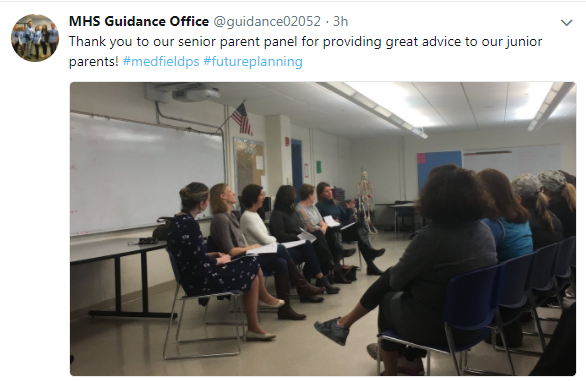
On April 11th the Guidance Department hosted a parent coffee for junior parents where a panel of senior parents shared advice about supporting their child through the college application process. Thank you to Faith Bannister, Monica Bushnell, Tina Caro, and Erica Reilly for being a part of the panel!

Below is a summary of the advice that was shared based on what worked best for each family.

Organizing the college application process

  • One strategy is to pick one day a week to talk about college so as not to overwhelm your child with college talk- especially if they aren’t much of a talker.
  • Keep a spreadsheet of the colleges and their deadlines
  • The Fiske Guide to Colleges and Demystifying College Admissions are great books to refer to.
  • Let your child drive the process and know that not everything will be done in the most efficient way. Yes, it’s helpful to have the college essay written before senior year begins, but if your child isn’t feeling inspired and in the mindset to write at that time it might not turn out to be the best essay.
College visits
  • Build some fun into it. Find the best consignment store in town or enjoy fun things to do in the area. Eat in the dining hall.
  • Keep it casual. Your child doesn’t have to decide if they are going to apply right after the visit. Think of it as simply gathering information about likes and dislikes
  • Know that there’s no perfect school for anyone. Instead, think about what qualities each school on your child’s list has that would help them to be happy and successful. 
  • After the college tour don’t say anything. Let your child talk first about their thoughts
  • One parent referred to a daunting part of the college info sessions called “the slide” where the admissions counselor brings up a slide with statistics about the number of AP courses, GPAs, and standardized test scores for their applicants. This can feel defeating to your child, but just because they don’t meet all that criteria it doesn’t mean that they won’t be accepted. Colleges are marketing themselves and want to appear selective.
Applying and deadlines
  • Apply where you want to go. It can’t hurt to try even if it’s a reach. Just make sure there are matches and likelys on your list.
  • Keep your blinders on. Social media and talk in the community can make things difficult. Do what you feel is right for your family and your child. 
  • Keep in mind that many Medfield students apply early action and will hear back in December. It can be difficult if your child hasn’t sent in any applications while their peers already have decisions in hand. Applying to a few likely schools early if your child is ready may be helpful. At the same time, applying regular decision can be nice because everything feels less rushed in the fall. 
  • There comes a point with the SATs or ACTs where the scores don’t change much. Taking one or both tests twice was the common number. At some point students should focus their energy on something else they have more control over.
  • Interviews- if you can, consider not interviewing the same day you do the campus tour and info session. It will be easier to go into an interview after you’ve had time to process your thoughts from the visit. If a college offers an optional interview and it’s one of your child’s top choices definitely take advantage of it. A lot of the big schools don’t provide it as an option. 
  • Whether or not interviews are offered have your child get to know the regional rep for each college. They can be a great source of information and an ally in the process. It can almost turn into an informal interview. 
  • ED is tricky as some students have a first choice early on in the process and then change their mind later on as they learn about more schools. You also may not have as many opportunities for merit scholarships and you are saying “yes” to a school before knowing what the financial aid looks like. The plus side is that if it’s truly the first choice and financially it works for the family, it might help to give the student a bit of an edge in the admissions process.
  • Don’t not apply to a school because of the price tag. One parent said that they would be paying less to go to a private school than UMASS because the private school offered merit scholarships. You never know what you will be asked to pay.
  • A great tip about the college essay- “If your child’s college essay fell out of their notebook while walking down the hallway at school and their name wasn’t on it, would people know it was theirs?” 
After decisions are released:
  • Know that you can only control so much. Help your child understand how to “separate the decision outcome from their own self worth”. Your child’s application could be amazing in every way, but you never know what the admissions committee’s priorities are that year. They are building a class.
  • Be open to unexpected outcomes. There may be disappointment with one school but a surprise yes at another school. One child was accepted to a college but was asked to go abroad for the first semester. It’s possible your child could get into their dream school but then realize when they get there it’s not what they expected. Sometimes the “nos” can lead to something else great. 
  • There are going to be “speed bumps and potholes” along the way, so expect that going into it. In the realm of life, your child is going to get nos- not getting the job they interviewed for or the promotion they want, etc. That’s your biggest role as a parent is to support them through the nos they will inevitably experience in life. 
  • Social media during decision release can be tough. There are group chats for colleges and oftentimes students are alerted about the date and time decisions will be released. Students immediately post their outcomes to the group chats and this can be overwhelming. Consider making a plan about how your child will manage this before decisions are released.
  • Tell your child “I don’t care what the sweatshirt says, I’m going to wear it with pride” whether its a selective school or not.

Monday, February 11, 2019

College Panel Highlights


by Amanda Padden

Last Thursday, the Guidance Department hosted a college panel where juniors and their parents heard about the admissions process from Bentley University, Boston College, Hobart and William Smith, UMASS Amherst, The University of New Hampshire, and Westfield State University. Here are a few highlights for those who were unable to make it:


Academic Supports at the College Level
  • The Banacos program at Westfield State offers support for students with Learning Disabilities and ADHD. Students who are accepted into the program are placed in classes with professors who are a good match for their learning style, get priority course registration for the first two years, and are assigned a program advisor who is a point person for any accommodations they may need. Students must submit cognitive and achievement testing, have a minimum GPA of 2.5, and interview with the program staff.
  • There are many different academic supports offered to all students at the college level including resources like tutoring and writing centers and peer tutors. Check with the colleges on your list to make sure that they offer the kinds of supports you will need to access. 
How colleges view students who apply undecided as a major
  • All six colleges say that being undecided is ok. Hobart said that they love undecided students. Students take an academic survey over the summer that help the deans place students with an advisor who is a good match and select freshman year classes that will be of interest to them.
  • Although being undecided is ok, there are certain majors that students cannot transfer into later. Often times these majors are Engineering, Nursing, and sometimes Business. BC for example says that students can’t transfer into the school of management, so they should apply to that academic division first and transfer out later.
  • UMASS made the point that if a student selects a competitive first choice major (like Nursing, Management, Engineering, or Computer Science) that they should pick a second choice major outside of that competitive college so they still have a chance to be admitted to the university if not admitted to their top choice major.
  • Students will want to check with their colleges to see if there are any majors or academic divisions that they can’t transfer into later
Is it better to have a high grade in a C1 or C2 course or a lower grade in an Honors or AP course?
  • UMASS and Westfield ad a .5 bump to the GPA for an Honors course and a 1.0 bump to the gpa for an AP course. 
  • In general the admissions counselors agreed that students should take courses that are an appropriate challenge for them. If you have all As in C1 classes and never take an honors course, that’s not a good thing. If a student earns all Cs in all Honors and AP courses then that’s not helping them either. Students should get feedback from their teachers, guidance counselor, and parents, and think about balance. 
  • Some colleges recalculate their own GPA. BC looks at the average grades in core subjects for every grade level. Hobart doesn’t recalculate, they take note of the rigor of the high school, strength of courses, and standardized tests if submitted. 
The college essay
  • Admissions counselors read the same stories over and over again like, “the day i got cut from the basketball team” or “the time I scored the last goal at my soccer game”. One of the most memorable stories was an essay about a pair of sneakers that a student loved.
  • Remember, this is not a writing assignment. It’s a chance to get to know you as a person. Write in your own voice and write about something important to you. Ask yourself “what do I want the essay to achieve and how will I do that?” or “What quality about myself do I want admissions to know about and how will I illustrate that quality?”
Interviews
  • If you have a first choice college make sure you reach out and ask if there’s an opportunity for an interview. For Hobart, it’s a red flag if a Medfield student hasn’t met with her because she lives locally and is very accessible.
  • If interviews are optional, it’s important to ask how important it is. Are they simply informational for the student or are they part of the admissions process?
  • Make sure you ask about the deadline to have an interview. Summer or fall of senior year is typically a good time. 
Volunteering vs. working?
  • No activity is more valuable than another. Admissions counselors simply want to know how each student spends their time outside of the classroom. Make sure to list any hobbies, jobs, or family responsibilities!
  • If a student is working 30 hours a week to support their family and takes no advanced classes because of that, they will take note of that in the admissions process.
Testing
  • There is a minimum standard set by board of higher ed for Westfield. SATs can be waived if the student has a documented disability. Admission decisions based on GPA and SAT.
  • Most schools agree that the SAT score can’t replace a student’s courses and grades. They also said that test prep can be a helpful resource, but it’s not essential or expected.
Deadlines
  • Admission deadlines and rates vary per college. For some colleges there’s a slightly higher admissions rate for Early Decision (binding) candidates. ED can help students who would be on the fence during regular admission get accepted. 
  • The colleges agreed that if it’s important to compare financial aid packages hat the student should not apply ED.
  • An advantage for regular decision is that admissions can see the first semester of senior year grades, so if students are unhappy with their 9th-11th grade grades, they may want to apply regular decision. 
Letters of recommendation
  • Ask a teacher from a core subject area. It doesn’t have to be the teacher who gave you the best grade. Oftentimes a teacher letter isn’t the “game changer”, but instead confirms what the admissions counselor is already perceiving from the application. Teacher letters can help make decisions about special invitations to honors programs (UMASS)
  • Counselor letters can be really helpful to give context or explain a transcript. Be sure you get to know your counselor so they can write a detailed letter for you
Pieces of advice for students and families:
  • Westfield- make sure you visit! Go to college fairs, see if junior visit days are offered, see if far away colleges have a regional rep you can talk to if you can’t get to campus. 
  • Bentley- Make an effort to know admissions counselor who is reading for your territory
  • UMASS- there’s no one school for you that you have to get into and all is lost. Keep an open mind. It’s all about what you make of it, the opportunities and the people you meet. 
  • BC- trust the process and just focus on what you’re doing in school. Don’t worry too much about the admissions process and how decisions are made.
  • Hobart- let the student be the driver. We want to hear from students not parents. Set aside one day a week to talk about college and not have it be a constant conversation. 

As you can see, there are different policies for every school, so be sure you are asking questions as you narrow down your list. The Guidance Department believes that there is a school for everyone and we will be here to individualize the process for every student and their family. Please reach out to us if you need anything and we hope that those of you who attended enjoyed the event!

Tuesday, January 22, 2019

Welcome Mrs. DiLuzio!


We are pleased to share that Mrs. Kathy Mahoney had a baby boy on Monday, January 21, 2019! Mrs. Mahoney will be out on maternity leave until May 28, 2019. Mrs. Alyse DiLuzio will be covering Mrs. Mahoney's leave. Mrs. DiLuzio is an experienced guidance counselor, having worked for many years with the students at Framingham High School. Most recently, Mrs. DiLuzio worked at Boston College as a program manager for their City Connects program. Mrs. DiLuzio earned her Bachelor of Arts degree from Providence College, and her Master of Arts in School Counseling from Boston College. 

Please welcome Mrs. DiLuzio to MHS! She can be reached at adiluzio@email.medfield.net

Thursday, October 18, 2018

Declining Resilience in College Students

By Kathy Mahoney
Resilience. It’s a word that pops up often when talking about youth, so much so that it is the theme of our Advisory program at MHS this year. What is resilience and why should we, as educators and parents, care? Definitions include the ability to recover quickly from difficulties, or being able to bounce back when faced with adversity. Research has shown that this trait is linked to future success and happiness.

A recent article from Psychology Today reports that colleges are seeing an increasing number of students that lack this quality. Counseling services are overwhelmed, professors are frustrated with students’ inability to solve even the simplest problems, and students are not learning to become responsible adults. How did we get here? And what can we do about it?

Dan Jones, former president of the Association for University and College Counseling Center Directors, says, “[Students] haven’t developed skills in how to soothe themselves, because their parents have solved all their problems and removed the obstacles. They don’t seem to have as much grit as previous generations.”

Dan goes on to say that he’s not trying to throw parents under the bus, as parents face many societal pressures raising kids in today’s world. These pressures have led them to manage and structure their kids’ lives in order to keep them safe, and to help them reach their potential, both noble goals. The downside, however, has been a “decline in opportunities [for kids] to play, explore, and pursue their own interests away from adults.” Anxiety and depression are up, and kids have less sense of control over their lives. When young people are not given opportunities to learn how to solve their own problems, get into trouble and find their way out, experience failure and realize they will survive, they become college-aged students that don’t know how to take responsibility for themselves, needing adult intervention when a problem arises.

In today’s world, a balance between structure and independence is needed if we are to build resilience. “If we want to prepare our kids for college—or for anything else in life—we have to counter these social forces. We have to give our children the freedom, which children have always enjoyed in the past, to get away from adults so they can practice being adults—that is, practice taking responsibility for themselves.”

Visit this link to read the article.

Monday, October 15, 2018

The Financial Aid Process


by Amanda Padden

Last Thursday Justin Munio, Financial Aid Officer at Harvard, talked with Medfield families about the financial aid process. The presentation was offered through the Massachusetts Educational Financing Authority (MEFA), which is a not-for-profit organization that helps families plan, save and pay for college. You can view the powerpoint on the guidance website to see the presentation, but I’ve included some main highlights and take away points below:
  • Check the financial aid website for all colleges you are applying to. Deadlines are very important. If you are applying early to colleges then financial aid documents may be due early as well.
  • The FAFSA and the CSS profile are the two forms that families typically have to complete. The FAFSA is free, but the CSS profile is not. Not all colleges require the CSS profile.
  • There are multiple sources of financial aid:
    • Federal Aid: You can get this by completing the FAFSA. This aid comes in the form of grants, loans, tax incentives and work study
    • Massachusetts Aid: Grants, scholarships, tuition waivers, and loans. (John and Abigail Adams scholarship determined by MCAS scores)
    • Institutional aid- offered by the individual colleges in the form of grants, work study, and scholarships.
    • Merit scholarships- some schools offer merit scholarships based on academics, athletics, the arts, etc. Many highly selective colleges (like the Ivys) don’t offer it because everyone is high achieving in the applicant pool.
    • Scholarships- local scholarships (Medfield students will get information about these in March) and scholarships from other agencies.
    • Of note- parent loans are NOT financial aid. You’ll want to look for grants, scholarships and student loans on the financial aid award letter.
  • Cost of Attendance
    • Direct expenses- tuition, fees, room/board
    • Personal expenses: books, travel, etc.
  • Cost of Attendance
  • Expected Family Contribution (EFC)- This is the minimum amount a family should be expected to pay for one student for one year. This is redetermined every year. An increase in income increases a family’s EFC. Savings does increase it, but only slightly.
  • Financial Aid Eligibility (need) is calculated by taking the COA and subtracting the EFC. Every college has a net price calculator on their website. Families can enter their personal information on each college’s website and get an estimate of their EFC.
  • Many colleges offer payment plans throughout the year so you do not have to pay your EFC in one lump sum.
The financial aid process can feel overwhelming for many families, but there are a lot of resources available that can help. Check out the following:

  • FAFSA Day is November 4th- families can get free assistance with filling out the FAFSA from a financial aid officer. Click here to view FAFSA day locations and to register: https://www.masfaa.org/fafsa-day-register/
  • MEFA offers After the College Acceptance seminars where families can get assistance with reviewing award letters and discuss loans, payment plans and questions that families should ask the financial aid office. These seminars are in March and April.
Always feel free to contact financial aid offices directly to ask questions. They are there to help!

Friday, September 28, 2018

Start With Hello

by Russ Becker

This week, Medfield’s R.E.N.E.W Project and Friends of Rachel club have been hard at work promoting the “Start With Hello” Movement. Start With Hello is put on by Sandy Hook Promise and it aims increase the welcoming nature of our school while decreasing social isolation among our students. The movement began with a simple idea that if you see someone by themselves, isolated and alone, sometime all you have to do is say hello to make them a part of your community. All week we have had students reading announcements to highlight the spirit of the movement, and we have handed out bingo boards that will encourage students to talk to others they may not know very well. Tomorrow our week concludes with a photo booth and a signed pledge to foster social inclusion at lunch. If you would like to know more please reach out and don’t forget to Start With Hello!


Thursday, September 27, 2018

Medfield Schools Attend D.A. Morrissey’s Collaborative Problem Solving Seminar

Press Release from the Norfolk County District Attorney's Office

Nationally acclaimed speaker and author Dr. J. Stuart Ablon, a Psychologist at Massachusetts General Hospital, was the guest of Norfolk District Attorney Michael W. Morrissey at an all-day training to help school districts deal with and find durable solutions to the most challenging and disruptive behaviors.

“The year after New York Police began training their school safety officers in Dr. Ablon’s ‘Think:Kids’ Collaborative Problem Solving® model in 2013, there was a 58 percent decrease in arrests made at school and 20 percent decrease in the reports of major crimes,” District Attorney Morrissey said. “Norfolk County schools may have different issues than any metropolis, but the solutions he offers work across demographics.”

More than 110 educators, school nurses, psychologists and adjustment counselors – including 40 school resource officers – took part in the September 20 event including Russ Becker, the adjustment counselor for Blake Middle and Medfield High School.

“Dr. Ablon’s methods are simple, but not easy. They start from the premise, rooted in research, that most kids ‘do well if they can’,” Morrissey said. “When they act out in school, the adults around them can be trained to work with them to identify, then teach the skills they need to succeed.”

The “Think: Kids” method is the opposite of permissiveness, but also avoids ineffective punishment models, Morrissey said. Instead, educators and school resource officers are trained in Collaborative Problem Solving – meaning the students are strategically engaged in coming up with resolutions to the conflict. In doing so, they improve skills that will prevent the problem from recurring.

“The new criminal justice reform act changes the role of school resource officers, removing them from enforcing school rules and discipline,” District Attorney Morrissey said. “Our training today provides information on research-based interventions being used across the country to address challenging student behavior without resorting to police powers or punitive steps.”

The research shows that collaborative problem solving creates more durable solutions to problematic behavior than either permissiveness or punitive action, and the District Attorney also sees benefits for the students as they age into adulthood.

“Helping students overcome poor impulse control, inability to manage irritability or disappointment, or help them learn to manage conflict – all while still in the safe environment of a school – can only help their future,” Morrissey said. “Spend a morning in any district courtroom and you will see petty assaults, property destruction and other crimes that arise from the same skill deficits.”

The conference was held in seminar space donated by the Bank of Canton at its corporate headquarters.

Contributed Photo info: Medfield Middle and High School Adjustment Counselor Russell Becker, left, joined more than 100 of his colleagues from across Norfolk County at the all-day training on effectively dealing with challenging behavior in schools hosted by Norfolk DA Michael W. Morrissey, right

Wednesday, September 12, 2018

A Lesson in Resiliency... from a Kindergarten Science Experiment

by Erik Ormberg


My wife and I will be completing our nineteenth year in education this spring. So, when a cool lesson is presented--or a gifted speaker inspires us--the topics oftentimes make their way to our dinner table. Last week my wife shared with me a story about a science project that I thought might resonate with the high school population.

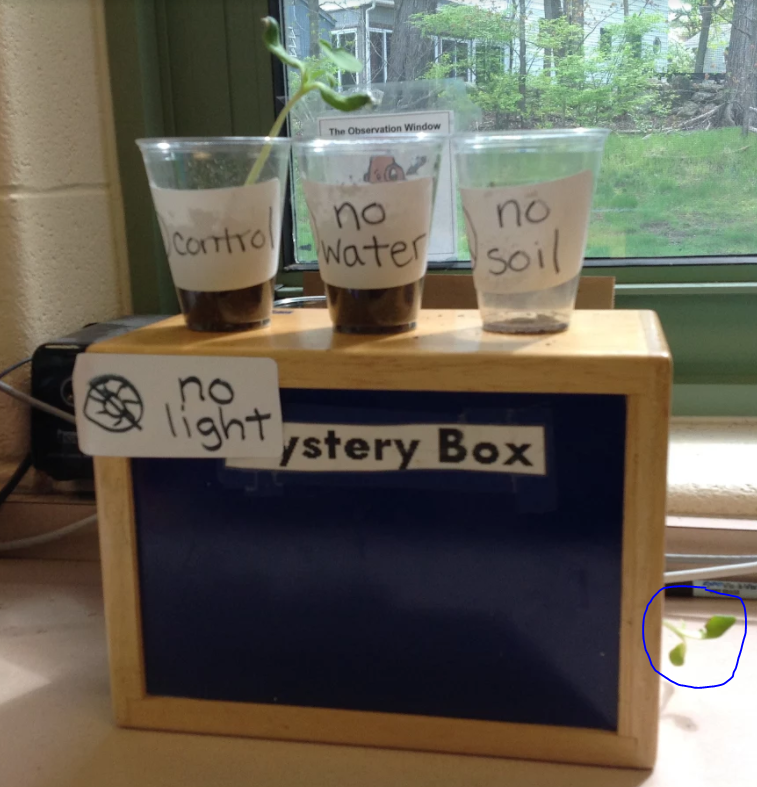
Her kindergarten class planted four plants.
  • Plant 1 was the CONTROL (It got everything...sun, soil, water and plant food)
  • Plant 2 got NO WATER
  • Plant 3 got NO SOIL
  • Plant 4 got NO LIGHT
In the photo above you see plant 4’s (NO LIGHT) leaves and stems peeking out on the side of the box, fighting for sunlight. No WATER and no SOIL never flourished, but no LIGHT fought hard for the one thing it needed. Sunlight.

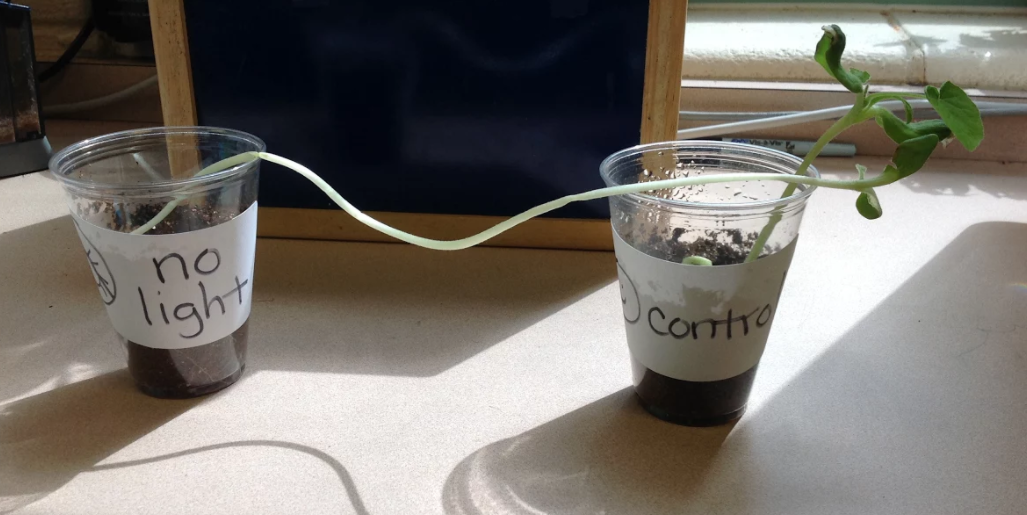
Once they took the NO LIGHT plant out of the box the students so how it had grown stronger and longer than the CONTROL plant that had everything it needed. The NO LIGHT plant had a better foundation for growth--or a better drive for growth.

This got me thinking about how much we provide our students. How we are often tempted to “clear a path for kids” as opposed to giving them what Malcolm Gladwell calls, “desirable difficulties.”

Do we set out for an “adversity-free” life for kids? Are we better serving students when the adversity teaches us a lesson that better prepares us for larger events later in life?

When students “earn” their way into an upper level course, or a spot on the team or a place on Student Government or National Honor Society there comes an intrinsic sense of worth and accomplishment. Similar to plant 4 these students have to stretch themselves a little further and work a little harder to get to where they want to go.

When I spoke to a student once about an English placement, she told me that her mom could have signed an override into honors, but the student wanted to “work her way” into the class as opposed to “signing her way” into the class. One mother told me, when her son lost eligibility for a sport due to a chemical health violation, “I want my kid to do three things, show remorse, repent and repeat.” One student embraced the challenge of earning her way into a class and one parent understood that discipline can teach. Someone once said, “it’s hard to learn a lesson from a mistake when there isn’t a consequence.”

As graduation looms for our seniors I think about the students who have earned so much of the accolades before them. The student on an IEP who overcame a learning difference. The kid who came to school actively willing to learn--doing what was asked of them minus the support of a parent, tutor or college coach. The child that was socially marginalized throughout high school but took counsel in one trusted adult or leaned on the acceptance of one common peer.

All of these students walk among us here at MHS. Some have managed their adversity with profound courage. Upon graduation most of our students will build on the identity they created here at MHS. Some will also be allowed to recreate that identity once they leave MHS.

Come Monday morning after the All Night Graduation Party I feel as though all our graduates become one again. They are all the same; on equal, yet uncertain, footing. The cliques are forced to change once the diplomas are in hand. All the unique differences that defined them melt away. One final time, as a class, they become whole again as they transition into the role of MHS alumni. Frightening thought for some--refreshing thought for others.

Amazing things can happen when “creative friction” exists or when a mountain appears before us--and we are forced to climb it knowing there is a reward on top. The goal maybe invisible at certain junctures, but crystal clear at other points. It has also been said that we “are much more sure-footed walking uphill than downhill.”

As our seniors shuffle out of MHS and into their newly found landing spaces we hope they bring with them an element of resiliency. We hope that they possess that special trait that allows them to assimilate to an unknown environment where conditions are not always optimal, but those conditions force them to reach further and grow stronger.


A picture of the NO LIGHT plant which grew longer and stronger than the CONTROL plant.

Thursday, August 30, 2018

Technology and Apps to Support Mental Health and Mindfulness

By Stephanie Worthley

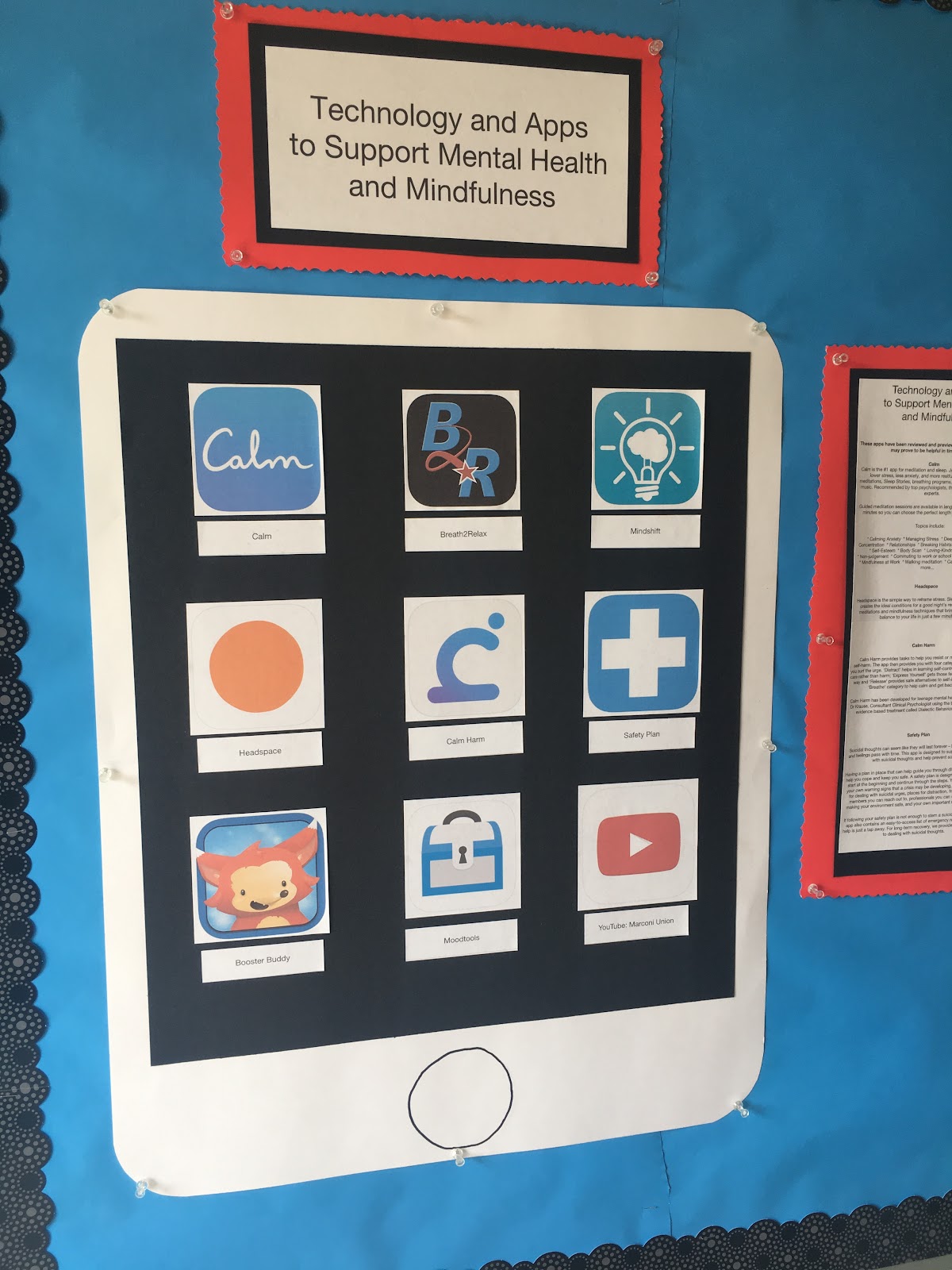
The MHS Counselors spent time this summer creating a toolbox of resources for our students to use when struggling with anxiety, depression, and other mental health conditions. Apps and websites can be effective in making therapy more accessible, efficient, and portable. The MHS Counselors used Summer R&D time to research apps and websites that can most efficiently help students whether at school or that they can access at home.

The following apps have all been reviewed and previewed by the MHS Counselors and may prove to be helpful in times of stress:

Calm
    Calm is the #1 app for meditation and sleep. Join the millions experiencing lower stress, less anxiety, and more restful sleep with our guided meditations, Sleep Stories, breathing programs, masterclasses, and relaxing music. Recommended by top psychologists, therapists, and mental health experts.
    Guided meditation sessions are available in lengths of 3, 5, 10, 15, 20 or 25 minutes so you can choose the perfect length to fit with your schedule.
    Topics include:
* Calming Anxiety * Managing Stress * Deep Sleep * Focus and Concentration * Relationships
* Breaking Habits * Happiness * Gratitude * Self-Esteem * Body Scan * Loving-Kindness
* Forgiveness * Non-judgement * Commuting to work or school * Mindfulness at College
* Mindfulness at Work * Walking meditation * Calm Kids * And so much more...

Headspace
Headspace is the simple way to reframe stress. Sleep trouble? Meditation creates the ideal conditions for a good night’s rest. Relax with guided meditations and mindfulness techniques that bring calm, wellness and balance to your life in just a few minutes a day.

Calm Harm
Calm Harm provides tasks to help you resist or manage the urge to self-harm. The app then provides you with four categories of tasks to help you surf the urge. ‘Distract' helps in learning self-control; ‘Comfort' helps you care rather than harm; 'Express Yourself' gets those feelings out in a different way and ‘Release' provides safe alternatives to self-injury. There is also a ‘Breathe' category to help calm and get back in control.
Calm Harm has been developed for teenage mental health charity stem4 by Dr Krause, Consultant Clinical Psychologist using the basic principles of an evidence based treatment called Dialectic Behaviour Therapy (DBT).

Safety Plan
Suicidal thoughts can seem like they will last forever – but these thoughts and feelings pass with time. This app is designed to support those dealing with suicidal thoughts and help prevent suicide.
Having a plan in place that can help guide you through difficult moments can help you cope and keep you safe. A safety plan is designed so that you can start at the beginning and continue through the steps. You can customize your own warning signs that a crisis may be developing, coping strategies for dealing with suicidal urges, places for distraction, friends and family members you can reach out to, professionals you can call, methods of making your environment safe, and your own important reasons for living.
If following your safety plan is not enough to stem a suicidal crisis, then this app also contains an easy-to-access list of emergency resources so that help is just a tap away. For long-term recovery, we provide a thorough guide to dealing with suicidal thoughts.

Mindshift
Struggling with anxiety? Tired of missing out? There are things you can do to stop anxiety and fear from controlling your life. MindShift is an app designed to help teens and young adults cope with anxiety. It can help you change how you think about anxiety. Rather than trying to avoid anxiety, you can make an important shift and face it.
MindShift will help you learn how to relax, develop more helpful ways of thinking, and identify active steps that will help you take charge of your anxiety.

Breath2Relax
Breathe2Relax is a portable stress management tool which provides detailed information on the effects of stress on the body and instructions and practice exercises to help users learn the stress management skill called diaphragmatic breathing.Breathing exercises have been documented to decrease the body’s ‘fight-or-flight’ (stress) response, and help with mood stabilization, anger control, and anxiety management.

Moodtools
If you are feeling sad, anxious, or depressed, lift your mood with MoodTools! MoodTools is designed to help you combat depression and alleviate your negative moods, aiding you on your road to recovery.
MoodTools contains several different research-supported tools. They include:
  - Thought Diary - Improve your mood by analyzing your thoughts and identifying negative / distorted thinking patterns based on principles from Cognitive Therapy
  - Activities - Regain your energy by performing energizing activities and tracking your mood before and after, based on Behavioral Activation Therapy
  - Safety Plan - Develop a suicide safety plan to keep you safe and utilize emergency resources during a suicidal crisis
  - Information - Read information, self-help guidelines, and find help with internet resources
  - Test - Take the PHQ-9 depression questionnaire and track your symptom severity over time
  - Video - Discover helpful YouTube videos that can improve your mood and behavior, from guided meditations to enlightening TED talks

Booster Buddy
Manage your personal wellness journey and earn achievements as your sidekick guides you through a series of daily quests designed to establish and sustain positive habits.
•Check-in with how you are feeling each day
•Use coping skills
•Keep track of appointments and medications
•Get started on tasks
•Follow self-care routines
•Increase real-life socialization

YouTube: Marconi Union
Relax and restore your mind body and soul
Neuroscience Says Listening to This Song Reduces Anxiety by Up to 65 Percent
The group that created "Weightless", Marconi Union, did so in collaboration with sound therapists. Its carefully arranged harmonies, rhythms, and bass lines help slow a listener's heart rate, reduce blood pressure and lower levels of the stress hormone cortisol.

https://www.inc.com/melanie-curtin/neuroscience-says-listening-to-this-one-song-reduces-anxiety-by-up-to-65-percent.html

Thursday, May 24, 2018

Standards Based Reporting

Standards Based Reporting
A principal gives us pause with some analytical thoughts on grading

by Erik Ormberg

On May 9th I sat in on a Sociology class as middle school principal Nat Vaughn presented on Standards Based Reporting.  I had heard about SBR in passing, but my knowledge remains limited. The only way I see SBR in action, in my mind, is when I look at my 9 year old’s 3rd grade report card.

Mr. Vaughn started off by asking the class “What’s the goal?  What are you here for?”

“To learn.”

He asked the students about how easy it is for them to pick out the “easy” teachers and the “hard” teachers.  Most of those opinions are created by the traditional A-F grading scale. Simple formula….the teacher who gives the most As is “easy” and the teacher who doesn’t is “hard.”  There was general agreement about these statements.

Mr. Vaughn then went off on the arbitrary nature of letter grades (the D+ always fascinated me….”you are doing excellently poor work”) and the even more inane “Comment Section”.  The canned two-comment component has long been established as protocol on report cards at both the high school and middle school. Report cards are littered with the non-academically pointed “pleasure to have in class,” or hard-hitting, “missing work has impacted grade” or the telling, “conduct good.”

One student pushed back by saying that their parents only cared about the comments and that the grades didn’t matter.  A telling sidebar as to what some people really want to see on a report card:  honest feedback that goes well beyond a random collection of quiz grades, test grades, homework grades, lab grades combined with extra credit, re-dos, book reports, test corrections, group projects, presentations, attendance and alternate assessments.

The main area of focus, as described by Mr. Vaughn, revolved around offering “an equitable experience for kids.”  Grading lacks consistency across disciplines and, oftentimes within disciplines.  

Mr. Vaughn shared a GRADE DISTRIBUTION REPORT showing three teachers who teach the same subject in the same grade.  In terms of “As” one teacher gave 19%, another 71% and another 54%. After seeing this deviation a decade ago, Mr. Vaughn started asking some questions about that lack of consistency.

After consulting with members of the math department Mr. Vaughn asked about “acceptable variations” on grade reports.  His findings concluded that 10% would be the acceptable variation. Given how far off the variation was he started to look at reasons why:

  • Is it different expectations?
  • Different types of assignments?
  • Teaching style?
  • How teachers weigh each grade?
  • Scaling?
  • Bonus questions/Extra Credit?
  • Calculator?
  • Partial credit?
  • Quiz/Test corrections?
  • Homework passes?
  • Drop the lowest grade?

Many of us in education...teachers/students/parents enjoy the perks of the homework pass or the policy of dropping the lowest grade.  We seem to like it when it benefits us.  But when we start looking at averages and the deviations that exist all of sudden our public school mandate that states all kids should be given a FAPE (Free and Appropriate Public Education) is called into question.

Mr. Vaughn then started to look at those “averages”.  Can students with the same grade be completely different students?  One student is a “grinder,” does all the homework and in-class assignments, but just doesn’t test well.  Another student, with the same grade, does half the homework assigned, pays little to no attention in class, but aces the tests.  If the student and parents see the same grade what might be more important is what is “behind the grade”: work ethic, group participation, willingness to push the conversation in class, effort and self-advocacy.

There were two slides in the powerpoint that captured my attention.  The first was a slide showed how most of the New England region is embracing SBR.  Massachusetts remains the one state not embracing SBR. The other interesting slide showed what traits people in the business world are looking for in a quality job applicant.

Top three: Bottom three:
Problem Solving Numeracy
Team work Emotional Intelligence
Communication Entrepreneurship

Do grades allow us to provide any feedback on these and other life skills and learning skills?  Are we accurately assessing students on CONTENT STANDARDS and LEARNING SKILLS when we give them grades?  

In thinking about how much technology has impacted the education of Medfield students in just the past five years I can think of other skill sets that are applied each day and graded and commented on through a system that seems far more draconian than cutting edge.

Mr. Vaughn stated that he likes “push back” from students and staff and today was not the day for that.  My question wasn’t WHY?.....but WHEN? Who will be first to rip down the old grading scale and integrate what we know are more telling descriptors of student learning.

As a high school guidance counselor I give much more than a cursory glance at a student’s transcript when I am writing a letter of recommendation.  But what I rely on more than GPA, ACT and SAT is our twenty-question Counselor Recommendation Form. Here is where we ask kids about their passions, how they deal with adversity, what their strengths and weaknesses are.  That form is much more telling of who the child is as a learner, musician, athlete, community servant or thespian.

Clearly Mr. Vaughn is passionate about the topic of SBR.  During a ninety minute block period he captivated the juniors and seniors in the class.  He took questions and provided some personal anecdotes about how kids learn differently, even sharing a story of a friend who hated his schooling experience all the way through college.  That friend has gone on to lead a very successful life with a fulfilling family and job.

After the presentation another discussion was had about providing staff the appropriate amount of time to do meaningful reflection and offer meaningful feedback for students--something that goes far beyond the “pleasure to have in class,” feedback we currently provide.  Many things need to change in order for this initiative to:
  1. Be meaningful for all
  2. Be accepted wholly as acceptable change
  3. Be more than a one-year initiative

My hope is that our current grading system moves in a direction that is more consistent for kids.  An argument was made today for Standards Based Reporting and, quite honestly, there wasn’t much pushback in the room.  

One of Mr. Vaughn’s final thoughts echoed as the students dispersed, “Students can learn without grades, but they can’t learn without timely, descriptive feedback.”


Thursday, April 5, 2018

“Let them drive the process….”


by Erik Ormberg


Five senior parents reflect on the future planning process


In early April the MHS Guidance office invited junior parents to hear from a panel of five senior parents as they shared thoughts on the future planning process. After two future planning events, two visits to classrooms and an upcoming college fair it was time for the guidance counselors to step aside, stop talking and let the parents in the trenches shares some insights, anecdotes and trade secrets.

We had a nice mix of “landing” spots. Two of the parents had kids committed to Providence College, two more were on the fence, one with Villanova and one with Temple and a final speaker’s child was going to decide between Loyola, Maryland or High Point University. The event was moderated by third-year guidance counselor, Kathy Mahoney.

Guidance department head, Stephanie Worthley kicked things off by welcoming the crowd of about forty and quickly turned things over to the panel.

Some general takeaways:
  • Tremendous stock was put in visiting colleges while school was in session and not during the quieter summer months.
  • Get a jump on essay writing and try to complete the common application over the summer.
  • Respect where each individual kid is in the process and allow a conversation to be had, or a spreadsheet designed or an essay assignment “outsourced” to a tutor.
  • Give the college admissions tests (ACT/SAT) their due diligence, but don’t sign up to take them more than 2 or 3 times.
  • Letting the students drive the process.
That last takeaway was a common thread that tied the entire morning together. As parents of seniors began the process they were intent on guiding their child and not becoming an overbearing presence amid the challenging timeframe of future planning with it’s written and unwritten deadlines.

One parent shared how their family began the process. The student was asked to come up with twenty schools based on interest. That list was then whittled down after a few visits and further research. She went on to explain that as a junior her son “THOUGHT” he wanted to go far from home, but as the sense of urgency became more real and vivid, he tended to look at schools closer to home.

At the end of the day is was clear to the audience that these five parents were not looking to relive a visceral experience through their children. A sense of individual pride permeated the discussion. And that pride wasn’t based on competitiveness or winning any specific brass ring. The pride was based on the fact that each parent knew their child had great options ahead of them.

And the driving force behind that? They let their child drive the process.

Tuesday, April 3, 2018

Sophomore Parent Night Recap

by Julia St. Jean

March 22, 2018 was the first annual Sophomore Parent Night run by the Guidance Department. The evening was filled with guidance-related information for sophomores, including a thorough junior year timeline, an overview of the sophomore guidance curriculum, an emphasis on the importance of life balance, an introduction into college and career readiness tools, and much more. In case you missed it, here are some takeaways from Stephanie Worthley, Russell Becker, Kathy Mahoney, Erik Ormberg, and Amanda Padden!

Sophomore Curriculum
During sophomore year, the Guidance Department connects with the entire sophomore class in classrooms about relevant topics to keep on their radar. During this interaction, counselors address and define high school transcripts, GPA and graduation requirements. Counselors also introduce Naviance (our online college and career platform) and it’s particular career exploration tools, including a Career Interests Profiler, which asks students a series of questions in order to determine which careers may be good fits as well as help students understand and set up resumes. These classroom visits get the process started in thinking about postgraduate plans as they relate to careers and best preparing students for their futures.

What Can Sophomores Do Now?
  • Attend the TEC College Fair at Westwood High School, which will be held on Wednesday, March 28, from 6:30-8:30
  • Career Speakers are coming to Medfield High! Individuals from different professions, including a Pediatric Nurse, Psychologist, Engineer, Sports Broadcaster, ESPN Talent Producer, Business Professional, and Teacher, are coming to visit the school to discuss the ins and outs of their particular career path.
Resources for Sophomores with Amanda Padden and Kathy Mahoney

In this breakout session, counselors drove home the importance of viewing sophomore year as a time of exploration and curiosity- what are your strengths and interests? How can you complement these through various types of involvement and conversations? We then walked through different available resources that help to support that exploration, including Naviance and Big Future- particularly which careers may be a good fit, how to get there, and what courses may be helpful to take.

Balance with Erik Ormberg and Russell Becker

Guidance Counselor Erik Ormberg and Adjustment Counselor Russell Becker focused on the importance of balance for high school students, encouraged families to discuss how they define success and how to accept and learn from stumbles along the way. They also spoke about mental health statistics in the greater Boston area and different mental health resources available to students and families, including speaking with our School Adjustment Counselor and reaching out to the Interface Helpline at 1-888-244-6843, which helps to connect individuals to therapists in the area.

Breakout Sessions: 
Guide to Postsecondary Planning for Students with Disabilities with Kathy Mahoney
Alternative Future Plans with Amanda Padden
Postgraduate Planning for Artists, Athletes, and Musicians with Erik Ormberg

There is an academic, educational, and career path for each student. While the process may feel daunting (which is very normal!) it is also incredibly exciting. Part of this juxtaposition of feelings is the hefty amount of options for students: what support services are available? What are my options once I receive a high school diploma? What if my college application requires a portfolio? These are all great (and common!) questions. As a Guidance Department, and school, there are resources, and people, here to help, and to hear, your questions, goals, and dreams, which will be unique and subjective for each student. Come visit us in Guidance to speak more about these topics!

Thursday, February 8, 2018

GAP Year Programs

by Amanda Padden

       On Friday, February 2nd, Gap year representatives from Dynamy Internship Year, EF Gap Year, Rustic Pathways, and City Year spoke with interested 10th-12th grade students and their parents. A Gap year is an "experiential semester or year typically taken between high school and college (or whatever your future plan may be) in order to deepen practical, professional, and personal awareness." Below you can find a summary of what each of the programs has to offer.

Dynamy: This program provides students an opportunity to explore potential careers and learn to live independently. Students live in Dynamy provided apartments in Worcester with other Dynamy students and attend their internship site roughly 28 hours a week. 200+ internships are offered, in careers a such as animal care, business, film, radio, and teaching - there’s something for everyone. Depending upon the whether students choose the full year or semester option, students will have between one and three internships. Mondays are workshop days where students learn about communication, independent living, and professional skills. They also have a chance to participate in college seminars offered through Clark University and earn up to 12 college credits. College counseling is available as well.

At the beginning of the program, students spend a week in Maine on an outdoor adventure retreat where they bond with staff and other students before the Gap year begins. Dynamy offers need based financial aid and has rolling admission throughout a student’s senior year until spots are filled.They also offer tours and informational interviews. Check out their website at https://www.dynamy.org/internship-year/.


EF Gap Year: EF is the same company that Medfield uses for its China and Italy trips. EF Gap Year offers students a chance to travel, learn or continue a world language, participate in community service, and intern in a field of interest. The program starts with an orientation at a castle in London (seriously!) where students get to know their cohort of Gap year students. As part of the orientation they will travel on a welcome tour to London, Amsterdam, Paris, Rome and Barcelona. After this, students will spend six weeks taking language courses at one of EF’s seven language schools in cities like Paris, Barcelona, Tamarindo, and Tokyo while staying with a host family. Next, students will participate in a six-week service learning project in one of six international destinations like the Dominican Republic, Nepal, Peru or Tanzania. Students return home for the holidays and have the option to attend a college application seminar.

When they return from break, students travel on a three week cultural immersion tour in Australia and New Zealand. After that students will start their business internship (offered in eleven international cities) where they will live with another EF Gap year student. The Gap Year ends with a Leadership Academy at the castle in London where students learn leadership skills followed by a tour of Scotland and Ireland where they practice those skills.

If students choose to participate for one semester they will only choose two of three options (service, language, internship) and will not travel to Australia and New Zealand. Applications are rolling until May 31st or until spots fill up. Students can enroll as early as their junior year, but most apply during senior year. https://www.ef.edu/pg/gap-year-abroad/


Rustic Pathways: This program offers students an opportunity to travel abroad and participate in community service. Students pick a region of interest and will travel to various countries within that region while participating in different service projects. There are typically fifteen students in a group, two program leaders, and local guides in each destination. Examples of programs are Spanish Immersion and Service and South Pacific Service and Ocean Skills.

Other specialized programs like “Come with Nothing” offers an experience where students bring one carry on bag and five items and have to shop for clothes and other supplies at a local market to sustain them throughout the trip. Students will live, work, and participate in community service.

Dates vary depending on the program destination. Rustic Pathways also offers summer programs if students do not want to participate during the academic year. Scholarships are offered and program applications deadlines vary. Check out their website at https://rusticpathways.com/


City Year: This program is for students interested in dedicating a year of service to students who are at risk of dropping out of school. City Year volunteers focus on student attendance, behavior, and the their ability to access the curriculum. City Year volunteers are assigned to a classroom where there is a primary teacher. Volunteers build relationships with the students in the classroom who are most at risk. Volunteers will be trained for one month before they are assigned to a site. Volunteers can choose to live at home or be assigned to a site in another US city and live in an apartment. Volunteers receive a stipend of roughly $630 every two weeks and can apply through City Year for food stamps to pay for groceries. Volunteers are in the classroom Mondays through Thursdays and spend Fridays with their City Year cohort.

Upon completion of the program, volunteers earn a financial award called the Segal Education Award of roughly $6,000 which can be used to pay off college debt or be put toward future schooling. City Year partners with colleges like Wheelock and Bentley which offer students incredible financial aid awards to City year alums. The application process includes talking with a recruiter, filling out an application, and having an interview. There are various deadlines throughout a student’s senior year with the next deadline coming up in early March, 2018. This is a well known program that has a huge alumni network. Many graduates of City Year are later hired by City year alums. This is a great opportunity for students interested in careers in education, helping professions, and working with youth. https://www.cityyear.org/


       Guidance counselors are available to work individually with students on the Gap year application process. See your counselor if you are interested in a Gap year or stop by the guidance office to explore the brochures. We want students to know that college is not the only option when it comes to future planning. As always, the guidance counselors look forward to helping students find a future plan that is both exciting and a great match for their skills and interests.

Thursday, December 21, 2017

Teen Depression and Suicide Linked to Smartphone Use


by Kathy Mahoney

NPR recently published a story about the dangerous connection between smartphones, depression, and suicide rates in teens. Research has shown a sharp increase in depression symptoms, suicide risk factors, and suicide rates in teens since 2012, coinciding with the time smartphones became popular.

The study found that teens who spend five or more hours a day on their phones are 71% more likely to have one risk factor for suicide. The amount of screen time, no matter the content, correlated to higher rates of depression.

The author of the study stated that “three hours a day and beyond is where you saw the more pronounced increase in those who had at least one suicide risk factor."

Recommendations for parents included limiting use to two hours per day or less. When not using smartphones, teens should be engaging in activities that promote mental health, such as exercising, seeing friends and family face to face, sleeping, and getting outside. Furthermore, the author reports that the ideal age that a teen should get a smartphone is 14, when they enter high school. Studies show that younger teens may be more vulnerable to the demands of social media.

To read the article in full, click here.

Thursday, October 19, 2017

Finsta! What is it?


by Stephanie Worthley

Image result for finsta

It's not just Instagram and Snapchat teenagers are using to express themselves. More and more teenagers are creating a Finsta - a fake Instagram account. Because Instagram now allows users to create and toggle quickly between multiple accounts, teens starting creating Finsta accounts in addition to their Instagram account. Why would someone create a Finsta account? Basically, teenagers are using their Finsta accounts to hide posts from their parents, teachers, employers, coaches, and even other peers. 

Finsta is a place where teenagers can be themselves outside of the filter-driven, perfect-photo culture of Instagram. While most teenagers often post to Instagram to gather a high number of likes and quick compliments, on Finsta, it is understood that likes, perfect photos, and comments are not the goal. Instead, many can post photos to express their real feelings, post imperfect photos, and share feelings that they may not always feel comfortable sharing in public. However, this is a place where teenagers are showing off pictures of illegal activities, such as drinking, drugs, parties, or sexual pictures - pictures that they would never post in a more public Instagram account (like the account their parents and family members are following). Finsta accounts are created to throw parents off of the teenagers digital path. Finsta accounts usually have fewer followers and engage with only a close circle of friends.

Here are some Finsta Realities:
  • Most teenage have a Finsta (although they will deny, deny, deny); while teenage girls dominate the space, boys are also active despite playing a less active role. Most teens (regardless of frequency of use) keep a Finsta account to remain privy to social hierarchy and look out for their own eventual targeting by other users.
  • It is more common to have a Finsta, than to not have a Finsta. Why? The platform allows teens to celebrate their social improprieties despite articulating or simulating remorse to parents and school officials. In other words, they are able to maintain a “sorry, I’m not sorry” persona on social media, while articulating the opposite in the public setting.
  • Although Finstas may begin with good intentions, most ultimately digress into a conduit for cyber aggression, or fan the flames of social drama in the form of likes, comments and regrams.
  • Finstas that create mental, social or emotional trauma are subject to school-related discipline if and when they eventually bleed into and disrupt the school learning environment. The lines of outside bullying and school have become increasingly blurred by social media platforms.
  • Upon discovery, teens easily (and alarmingly) convince parents the Finsta is “only a joke” or “actually never used”, and quickly change their handle (name) to advance the premise that it has been deleted. Rarely, if ever, do they actually delete their Finsta.
Ask your son or daughter to show you their Finsta account. It may be difficult to find it, depending on the account name and the photo that is used to create the profile picture.

Resources:
https://www.today.com/parents/parents-you-know-about-instagram-do-you-know-finsta-t117541

https://securingtomorrow.mcafee.com/consumer/family-safety/finsta-parents-know-teens-fake-instagram-accounts/

https://www.huffingtonpost.com/entry/what-the-finsta-the-darker-world-of-teenagers-and_us_57eb9e03e4b07f20daa0fefb

Friday, September 22, 2017

Swimming with the Sharks - A Take on Selective Admissions

NACAC-2018-720x360.png

by Kathy Mahoney

Last week, I had the opportunity to attend the National Conference for NACAC - the National Association for College Admission Counseling. My first session focused on how best to counsel students and families in a competitive and demanding admissions climate. There are thousands of students applying to each school, and colleges have the difficult job of building an admissible class. This task includes denying talented students, many of whom meet the admissions criteria and would make fantastic students at their institution. With the number of applications rising and admissions rates falling, it’s no wonder that students and families feel like they are left swimming with the sharks. Here are two big takeaways to keep in mind as you go through the process.

     1). There is no such thing as fairness in the admission process. It’s easy to compare yourself with others around you, but try not to fall into that trap. “I have a better GPA than Johnny, but Johnny got in and I didn’t. That’s not fair.” However, Johnny plays the oboe and the college happens to be short one oboe player. GPA clearly wasn’t the only factor in this admission decision. The following year, Sarah says, “I have a better GPA than Johnny did and I’m a better oboe player!” Well, the school doesn’t need an oboe player anymore; their institutional priorities have shifted. Fairness in college admissions just isn’t possible.

     2). Think outside the box! In this case, the box is the Northeast and West Coast. These schools have been hit by increasing amounts of applications, leading to tougher standards and lower admission rates. By contrast, there are hundreds of great schools everywhere in between that might be a perfect fit for you! Colleges like geographic diversity and may be more likely to admit a candidate from a state that has little representation at their school. Keep an open mind and look at schools outside of our region to increase your likelihood of admission. There are some real gems out there!

Remember to work with your guidance counselor to come up with a list of colleges that is right for you. We look forward to helping you!