We would like to congratulate Mrs. Anne Lodge on the birth of her baby boy, Thomas Edward Lodge! While Mrs. Lodge is out on her maternity leave, we would like to welcome Ms. Julia St. Jean to the MHS Guidance Department. Ms. St. Jean is a graduate of Boston College and was a Mater's Level Research Assistant at Northwestern University. Most recently, Ms. St. Jean has been working as a Guidance Counselor at Bishop Fenwick High School. We are excited to have Ms. St. Jean join our department. Please welcome Ms. St. Jean to MHS!
Tuesday, January 16, 2018
Thursday, December 21, 2017
Teen Depression and Suicide Linked to Smartphone Use
by Kathy Mahoney
NPR recently published a story about the dangerous connection between smartphones, depression, and suicide rates in teens. Research has shown a sharp increase in depression symptoms, suicide risk factors, and suicide rates in teens since 2012, coinciding with the time smartphones became popular.
The study found that teens who spend five or more hours a day on their phones are 71% more likely to have one risk factor for suicide. The amount of screen time, no matter the content, correlated to higher rates of depression.
The author of the study stated that “three hours a day and beyond is where you saw the more pronounced increase in those who had at least one suicide risk factor."
Recommendations for parents included limiting use to two hours per day or less. When not using smartphones, teens should be engaging in activities that promote mental health, such as exercising, seeing friends and family face to face, sleeping, and getting outside. Furthermore, the author reports that the ideal age that a teen should get a smartphone is 14, when they enter high school. Studies show that younger teens may be more vulnerable to the demands of social media.
To read the article in full, click here.
Thursday, October 19, 2017
Finsta! What is it?
by Stephanie Worthley
(1).jpg)
It's not just Instagram and Snapchat teenagers are using to express themselves. More and more teenagers are creating a Finsta - a fake Instagram account. Because Instagram now allows users to create and toggle quickly between multiple accounts, teens starting creating Finsta accounts in addition to their Instagram account. Why would someone create a Finsta account? Basically, teenagers are using their Finsta accounts to hide posts from their parents, teachers, employers, coaches, and even other peers.
Finsta is a place where teenagers can be themselves outside of the filter-driven, perfect-photo culture of Instagram. While most teenagers often post to Instagram to gather a high number of likes and quick compliments, on Finsta, it is understood that likes, perfect photos, and comments are not the goal. Instead, many can post photos to express their real feelings, post imperfect photos, and share feelings that they may not always feel comfortable sharing in public. However, this is a place where teenagers are showing off pictures of illegal activities, such as drinking, drugs, parties, or sexual pictures - pictures that they would never post in a more public Instagram account (like the account their parents and family members are following). Finsta accounts are created to throw parents off of the teenagers digital path. Finsta accounts usually have fewer followers and engage with only a close circle of friends.
Here are some Finsta Realities:
Resources:
https://www.today.com/parents/parents-you-know-about-instagram-do-you-know-finsta-t117541
Here are some Finsta Realities:
- Most teenage have a Finsta (although they will deny, deny, deny); while teenage girls dominate the space, boys are also active despite playing a less active role. Most teens (regardless of frequency of use) keep a Finsta account to remain privy to social hierarchy and look out for their own eventual targeting by other users.
- It is more common to have a Finsta, than to not have a Finsta. Why? The platform allows teens to celebrate their social improprieties despite articulating or simulating remorse to parents and school officials. In other words, they are able to maintain a “sorry, I’m not sorry” persona on social media, while articulating the opposite in the public setting.
- Although Finstas may begin with good intentions, most ultimately digress into a conduit for cyber aggression, or fan the flames of social drama in the form of likes, comments and regrams.
- Finstas that create mental, social or emotional trauma are subject to school-related discipline if and when they eventually bleed into and disrupt the school learning environment. The lines of outside bullying and school have become increasingly blurred by social media platforms.
- Upon discovery, teens easily (and alarmingly) convince parents the Finsta is “only a joke” or “actually never used”, and quickly change their handle (name) to advance the premise that it has been deleted. Rarely, if ever, do they actually delete their Finsta.
Resources:
https://www.today.com/parents/parents-you-know-about-instagram-do-you-know-finsta-t117541
https://securingtomorrow.mcafee.com/consumer/family-safety/finsta-parents-know-teens-fake-instagram-accounts/
https://www.huffingtonpost.com/entry/what-the-finsta-the-darker-world-of-teenagers-and_us_57eb9e03e4b07f20daa0fefb
Tuesday, September 26, 2017
Bright Kids Who Can't Keep Up
by Matt Marenghi
Over the course of middle school, academic standards and expectations naturally progress and students must meet the increasing demands. Among all the reasons that a student could possibly have difficulty meeting such demands, I’ve often learned “processing speed” is the culprit. The book Bright Kids Who Can’t Keep Up provides both a thorough understanding of processing speed and practical approaches to support students who are adversely affected by it.
From the author’s work with Learning and Emotional Assessment Program (LEAP) out of Massachusetts General Hospital, the book indicates that 77% of children with processing speed deficits were currently receiving formalized IEP or 504 support, further indicating the overwhelming impact processing speed has on academic progress.
The book explains processing speed as an executive functioning skill, making it analogous to the engine of a car; having a more powerful and/or efficient engine will allow the car to move faster and/or run more efficiently. Processing speed has implications for a child’s home environment, social life, and emotional stability/well-being. This book struck a chord with my parental lens with the following passage:
This speaks to the patience that is necessary in supporting children with processing speed issues, and how a lack thereof can only dramatically exacerbate frustrating situations.
Further to this end, I did find this book to likely be more valuable for parents than for educators (though it is by no means not valuable for educators :) It really confronts the more intimate issues relative to processing speed issues, but does a great job of offering practical strategies to manage them. Thematically weaved into the book is the strategy of implementing the “Three As”: Accept, Accommodate, and Advocate.
In my professional role of supporting students, this book boosted my confidence and thickened the context by which I can have these types of conversations with families. I recommend it both to anyone just entering, or in the thick of these types of conversations.
Over the course of middle school, academic standards and expectations naturally progress and students must meet the increasing demands. Among all the reasons that a student could possibly have difficulty meeting such demands, I’ve often learned “processing speed” is the culprit. The book Bright Kids Who Can’t Keep Up provides both a thorough understanding of processing speed and practical approaches to support students who are adversely affected by it.
From the author’s work with Learning and Emotional Assessment Program (LEAP) out of Massachusetts General Hospital, the book indicates that 77% of children with processing speed deficits were currently receiving formalized IEP or 504 support, further indicating the overwhelming impact processing speed has on academic progress.
The book explains processing speed as an executive functioning skill, making it analogous to the engine of a car; having a more powerful and/or efficient engine will allow the car to move faster and/or run more efficiently. Processing speed has implications for a child’s home environment, social life, and emotional stability/well-being. This book struck a chord with my parental lens with the following passage:
Studies have shown that when family members argue, both volume and rate of speech increase dramatically - as much as two to three times - which should be no shock to anyone who’s had a passionate discussion or disagreement with someone.
This speaks to the patience that is necessary in supporting children with processing speed issues, and how a lack thereof can only dramatically exacerbate frustrating situations.
Further to this end, I did find this book to likely be more valuable for parents than for educators (though it is by no means not valuable for educators :) It really confronts the more intimate issues relative to processing speed issues, but does a great job of offering practical strategies to manage them. Thematically weaved into the book is the strategy of implementing the “Three As”: Accept, Accommodate, and Advocate.
In my professional role of supporting students, this book boosted my confidence and thickened the context by which I can have these types of conversations with families. I recommend it both to anyone just entering, or in the thick of these types of conversations.
Friday, September 22, 2017
Swimming with the Sharks - A Take on Selective Admissions
by Kathy Mahoney
Last week, I had the opportunity to attend the National Conference for NACAC - the National Association for College Admission Counseling. My first session focused on how best to counsel students and families in a competitive and demanding admissions climate. There are thousands of students applying to each school, and colleges have the difficult job of building an admissible class. This task includes denying talented students, many of whom meet the admissions criteria and would make fantastic students at their institution. With the number of applications rising and admissions rates falling, it’s no wonder that students and families feel like they are left swimming with the sharks. Here are two big takeaways to keep in mind as you go through the process.
1). There is no such thing as fairness in the admission process. It’s easy to compare yourself with others around you, but try not to fall into that trap. “I have a better GPA than Johnny, but Johnny got in and I didn’t. That’s not fair.” However, Johnny plays the oboe and the college happens to be short one oboe player. GPA clearly wasn’t the only factor in this admission decision. The following year, Sarah says, “I have a better GPA than Johnny did and I’m a better oboe player!” Well, the school doesn’t need an oboe player anymore; their institutional priorities have shifted. Fairness in college admissions just isn’t possible.
2). Think outside the box! In this case, the box is the Northeast and West Coast. These schools have been hit by increasing amounts of applications, leading to tougher standards and lower admission rates. By contrast, there are hundreds of great schools everywhere in between that might be a perfect fit for you! Colleges like geographic diversity and may be more likely to admit a candidate from a state that has little representation at their school. Keep an open mind and look at schools outside of our region to increase your likelihood of admission. There are some real gems out there!
Remember to work with your guidance counselor to come up with a list of colleges that is right for you. We look forward to helping you!
1). There is no such thing as fairness in the admission process. It’s easy to compare yourself with others around you, but try not to fall into that trap. “I have a better GPA than Johnny, but Johnny got in and I didn’t. That’s not fair.” However, Johnny plays the oboe and the college happens to be short one oboe player. GPA clearly wasn’t the only factor in this admission decision. The following year, Sarah says, “I have a better GPA than Johnny did and I’m a better oboe player!” Well, the school doesn’t need an oboe player anymore; their institutional priorities have shifted. Fairness in college admissions just isn’t possible.
2). Think outside the box! In this case, the box is the Northeast and West Coast. These schools have been hit by increasing amounts of applications, leading to tougher standards and lower admission rates. By contrast, there are hundreds of great schools everywhere in between that might be a perfect fit for you! Colleges like geographic diversity and may be more likely to admit a candidate from a state that has little representation at their school. Keep an open mind and look at schools outside of our region to increase your likelihood of admission. There are some real gems out there!
Remember to work with your guidance counselor to come up with a list of colleges that is right for you. We look forward to helping you!
Tuesday, September 19, 2017
“ROLL TIDE!”: The SEC via a “drive-thru window approach”
by Erik Ormberg
During the second week of September I had the chance to attend the SEC (South Eastern Conference) admissions breakfast.
The group of college representatives presented in Portland, ME, Boston, MA and Providence, RI three days in a row.
The event can be summed up in three minutes. Literally.
Each school had three minutes to give their overview--and if they went over, the representative from Mississippi State rang a cowbell. Though not as subtle as the orchestra playing at the Oscars when recipients go over their time limit, the group--for the most part--stayed committed to their time constraints. Brevity was the main course at this breakfast forcing each school to get to the nitty-gritty of their admissions trends and policies.
Getting a snapshot from 14 schools in less than two hours is exactly how I want to get my information about schools that are over 1000 miles from Medfield.
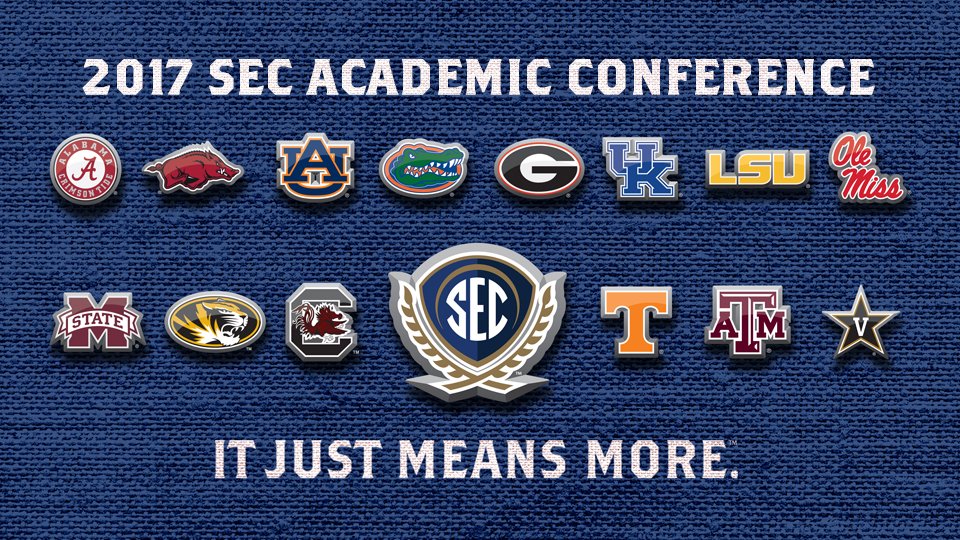
After a quick overview from LSU, each school’s representative performed their respective, “roll call.” Each guidance counselor in the room had to perform the college’s rally cry. So, we all engaged in ‘Bama’s “Roll Tide,” Auburn’s “War Eagle,” Florida’s “Gator Chop,” and Ole Miss’s “Hotty Toddy.”
Roll call got everyone moving and set the tone. Fourteen schools presented admissions trends and statistics, but also emphasized the large, VOCAL, vibrant school spirit present on each campus.
I had the pleasure of sitting next to Clay Alexander, admissions representative from the University of Tennessee. He looked like the endzones of Neyland stadium, adorned in an orange checkerboard shirt and vintage UT orange tie. “Rocky Top you’ll always be, home sweet home to me.”
Our conversation revolved around the recalculating of GPAs, rankings, and the strength of schedule and strength of institution. Though he didn’t go into detail, Clay did explain that the school profile provided by each high school plays a large part in admissions. The strength of a public high school may help enhance a student’s application.
Though this “drive-thru” approach didn’t dive deep, the materials given and the comments presented were extremely helpful in identifying schools for kids looking to venture beyond New England and the northeast corridor.
After leaving Providence, I thought about the senior girl in my office the day prior looking for a “safety-school.” Having her GPA and board scores still bouncing around my head made me realize she’d be a great candidate for the University of South Carolina’s honors college.
I wish more gatherings of colleges or leagues would follow suit. It is helpful for counselors to only miss part of their work day, yet still receive helpful professional development without having to travel hundreds of miles. “MIZ….ZOU!”
The group of college representatives presented in Portland, ME, Boston, MA and Providence, RI three days in a row.
The event can be summed up in three minutes. Literally.
Each school had three minutes to give their overview--and if they went over, the representative from Mississippi State rang a cowbell. Though not as subtle as the orchestra playing at the Oscars when recipients go over their time limit, the group--for the most part--stayed committed to their time constraints. Brevity was the main course at this breakfast forcing each school to get to the nitty-gritty of their admissions trends and policies.
Getting a snapshot from 14 schools in less than two hours is exactly how I want to get my information about schools that are over 1000 miles from Medfield.

After a quick overview from LSU, each school’s representative performed their respective, “roll call.” Each guidance counselor in the room had to perform the college’s rally cry. So, we all engaged in ‘Bama’s “Roll Tide,” Auburn’s “War Eagle,” Florida’s “Gator Chop,” and Ole Miss’s “Hotty Toddy.”
Roll call got everyone moving and set the tone. Fourteen schools presented admissions trends and statistics, but also emphasized the large, VOCAL, vibrant school spirit present on each campus.
I had the pleasure of sitting next to Clay Alexander, admissions representative from the University of Tennessee. He looked like the endzones of Neyland stadium, adorned in an orange checkerboard shirt and vintage UT orange tie. “Rocky Top you’ll always be, home sweet home to me.”
Our conversation revolved around the recalculating of GPAs, rankings, and the strength of schedule and strength of institution. Though he didn’t go into detail, Clay did explain that the school profile provided by each high school plays a large part in admissions. The strength of a public high school may help enhance a student’s application.
Though this “drive-thru” approach didn’t dive deep, the materials given and the comments presented were extremely helpful in identifying schools for kids looking to venture beyond New England and the northeast corridor.
After leaving Providence, I thought about the senior girl in my office the day prior looking for a “safety-school.” Having her GPA and board scores still bouncing around my head made me realize she’d be a great candidate for the University of South Carolina’s honors college.
I wish more gatherings of colleges or leagues would follow suit. It is helpful for counselors to only miss part of their work day, yet still receive helpful professional development without having to travel hundreds of miles. “MIZ….ZOU!”
Subscribe to:
Posts (Atom)